
How should the imam who will lead a prayer to the congregation make the intention (niyyah)?
Dear Brother / Sister,
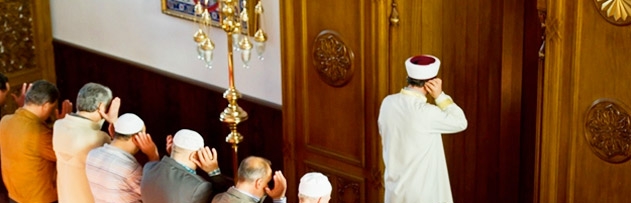
When the imam who will lead, for instance, the noon prayer, he makes the intention (niyyah) as follows: "I intend to perform the noon prayer of today and to lead it as the imam." In fact, he does not have to intend to be the imam. However, if there are also women that will follow the imam, he needs to intend to be the imam. Intention essentially consists of determination and definite will. It means the heart deciding something and knowing what something is done for without thinking.
Intention about prayer means to want to perform a prayer for Allah and to know what prayer to perform. The importance and rewards of deeds are based on intentions. Man's intention should be sincere (only for Allah's sake). Man should perform worshipping consciously. He should seek a lofty purpose like Allah's consent with the deed he does and he should not be heedless.
Intention belongs to the heart. However, it is better to utter the intention with the tongue after making it with the heart. If a person makes the intention with the heart before a prayer but does not utter it with his tongue, his prayer is valid. However, it is better to say, "I intend to perform the fard or sunnah of this time" along with the intention made by the heart. Thus, it is mustahab to make the intention both with the heart and the tongue according to the sound view. The intention made only with the tongue, without intending by the heart, is not valid.
While performing fard prayers, eid prayers and witr prayers, it is necessary to determine what times they are. Intention is made as follows: I intend to perform "today's morning prayer" or "today's Friday prayer, today's witr prayer, today's eid prayer ". It is not enough to intend for the fard prayer only. The fard prayer is not determined with such an intention. However, it is enough to intend by saying "I intend to perform the fard of this time (period)" without mentioning the name of the prayer. There is no need to mention the number of rak'ahs. However, Friday prayer is not like that. It is not performed with the intention of the time because it is the time for the noon prayer, not the Friday prayer.
As for nafilah (supererogatory) prayers, it is enough to intend to perform a prayer in them. However, they are performed by uttering an intention like the first or last sunnah of this or that time. However, one should intend as follows: for tarawih prayer: "I intend to perform tarawih prayer or the sunnah of this time." This is more appropriate.
If a person sees a congregation but does not know whether they are performing the fard of the night prayer or tarawih prayer, he follows the imam by intending to perform the fard prayer. If it is a fard prayer, his prayer is valid. If it is tarawih prayer, his prayer is regarded as a nafilah prayer. It is not regarded as tarawih prayer because tarawih cannot be performed before the fard of the night prayer.
It is more virtuous to utter the intention close to the time of takbir. It is permissible to intend earlier but there must not be any state contrary to prayer between the intention and takbir.
An example: If a person makes intention while making wudu to perform a prayer, goes to the place where he performs the prayer and starts prayer without doing anything like eating, drinking and speaking that are contrary to prayer, his prayer is valid. Even if he does not utter the intention, his prayer is valid. However, a prayer is not valid with an intention made after takbir, which is the preferred view. According to another view, a prayer is valid if intention is made after takbir but before subhanaka and audhu… (According to Imam Shafii, it is necessary for the intention to be made close to takbir.)
A prayer is valid when intention is made for a missed (qada) prayer while performing a fard prayer and when intention is made for a fard prayer while performing a missed (qada) prayer.
An example: If a person intends to perform the fard of the noon prayer thinking that the time period for the noon prayer has not ended yet and understands after completing his prayer that the time period for the noon prayer ended before he started his prayer, the prayer he has performed is regarded as a qada prayer.
If a person intends for the noon and the afternoon prayer at the time period that seemed as the noon, his intention becomes valid for the prayer whose time period has started. The prayer whose time prayer has not started does not prevent it.
If a person starts a prayer intending for the fard prayer of the time and finishes his prayer thinking that he is performing a nafilah prayer, his prayer is regarded as the fard prayer because it is not necessary to remember the intention up to the end of the prayer.
If a person intends for a nafilah prayer and intends for a fard prayer after takbir, he is regarded to have started a fard prayer. The opposite of it is also like that.
If a person intends for the fard of the noon prayer and after performing one rak'ah intends for the fard of the afternoon prayer or a nafilah prayer, he is regarded to have abandoned the noon prayer and started the prayer according to the second intention.
It is also necessary to make intention when a person follows the imam in a congregation: "I intend to perform the fard of the noon prayer and to follow this imam." If intention is not made like that, following the imam is not valid.
If a person who has started to perform a prayer individually intends to follow the imam and utters takbir with his tongue, he is regarded to have abandoned his previous prayer and followed the imam.
According to the preferred view, it is not enough for a person who follows the imam to intend by saying only, "I follow the imam" without mentioning the name of the prayer. It is also the same to say, "I intend to perform the prayer with the imam."
If a person intends to follow the imam and starts the prayer but the imam has not started yet, this following is not valid. He is not regarded to have followed the imam even when he finishes uttering the word "Allah" or "Akbar" before the imam finishes. However, if he utters a takbir again, he is regarded to have followed the imam with this second takbir.
The intention of the congregation to follow the imam should be made after the imam says "Allahu Akbar" and starts the prayer so that he would follow a person who is performing a prayer and there would be no possibility of uttering takbir before the imam. This is the view of Imam Abu Yusuf and Imam Muhammad. According to Abu Hanifa, the takbir of the congregation should be close to the takbir of the imam because it includes the virtue of hurrying for worshipping. Then, the intention should be early. However, a person who utters takbir and starts to follow the imam before the imam finishes the chapter of al-Fatiha receives the thawab of the takbir of iftitah (beginning).
It is not necessary to know the imam who is leading the prayer. For instance, if a person thinks that the imam he is following in the prayer is Hasan but finds out that he is Bakr, it does not harm the prayer. However, if he makes the intention saying that I am following the imam Hasan but finds out that the imam is somebody else, his following is not valid. For, this intention is based on a condition.
The person who is the imam does not have to make an intention to lead the prayer. However, he has to make an intention to lead the prayer if women are to follow him. If the imam says, "Ana imamun liman tabiani = I am the imam of those who follow me", women can follow him.
(Ömer Nasuhi Bilmen, Büyük İslam İlmihâli)
Questions on Islam
- How is intention (niyyah) made for prayers? How are intentions made in Arabic? Are there any differences in intentions based on madhhabs? Do intentions change based on madhhabs?
- What does the sunnah of the time of two rak’ahs performed after Friday prayer mean? We pray four rak’ahs of the last sunnah after the fard of Friday prayer anyway.
- How Many Pillars (Essential Parts) are there in a Prayer?
- Can missed fard prayers be performed instead of tarawih prayer according to Shafii and Hanafi madhhabs? Is it permissible to perform missed fard prayers by following the imam in that case?
- Under which conditions can a man lead prayers to women? How is intention for being the imam made? Is it necessary to make a separate intention for women?
- Eid and Eid Prayers
- It is said that the Prophet (pbuh) prayed only eight rak’ahs of tarawih. Why do we pray twenty rak’ahs?
- How is Prayer (salah) performed?
- How is Prayer (salah) performed?
- Is it permissible to intend to combine prayers if there is a possibility of missing a prayer? and In what situations can one imitate other madhhabs (sects) and combine prayers?


