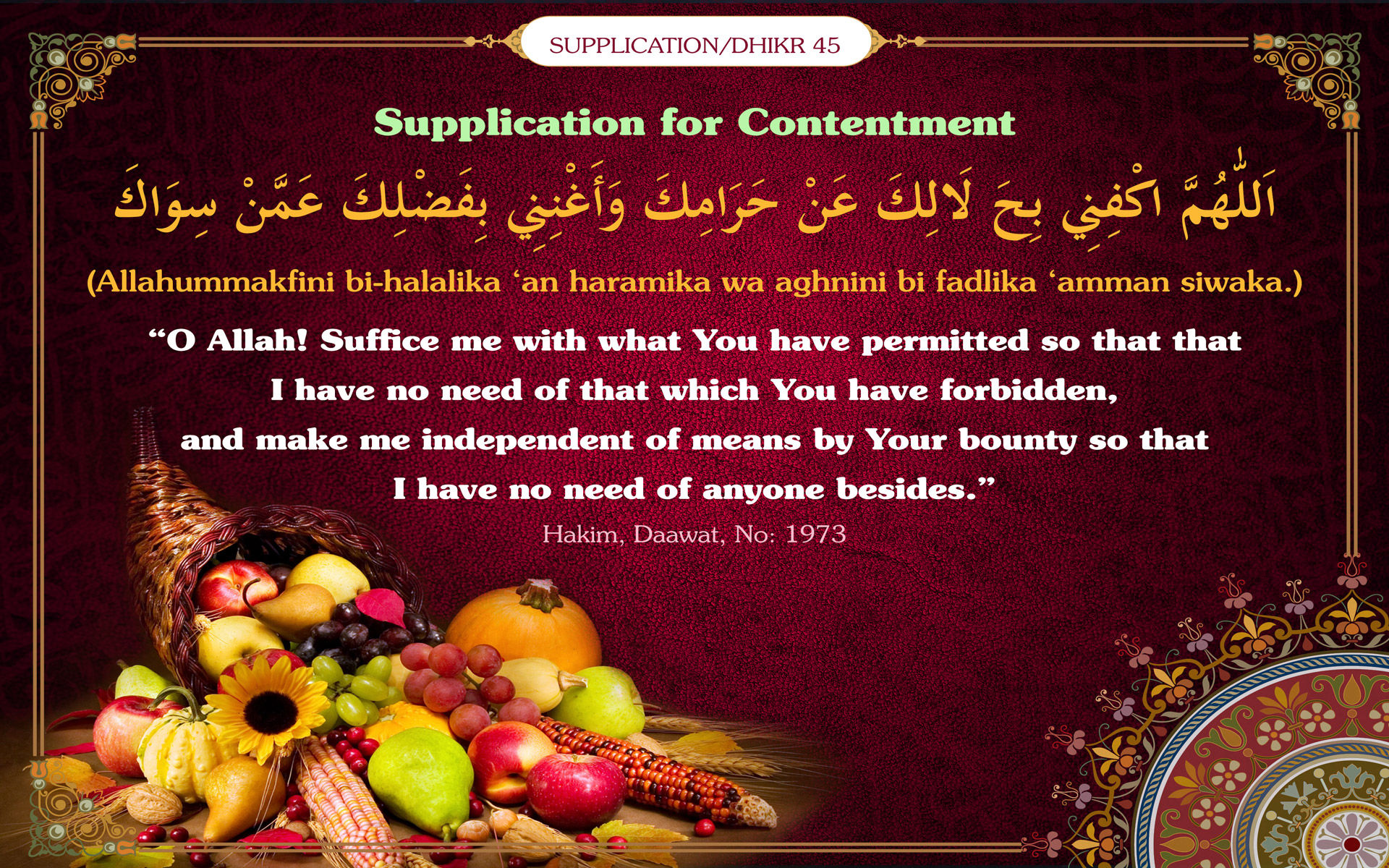
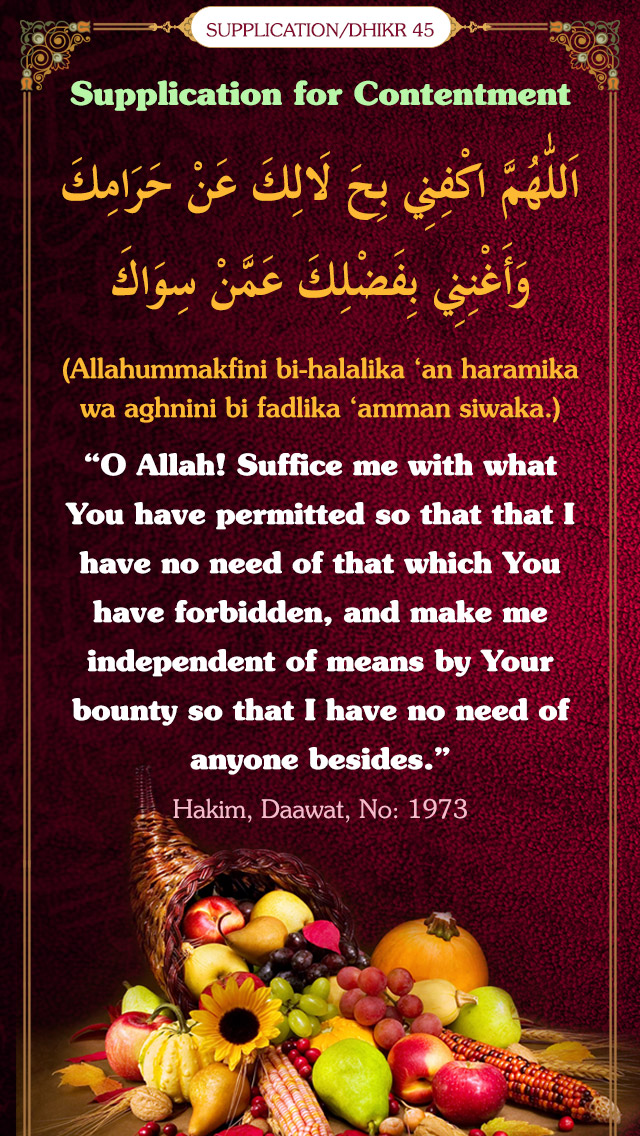
Supplication for Contentment
اَللّٰهُمَّ اكْفِنِي بِحَ لَالِكَ عَنْ حَرَامِكَ وَأَغْنِنِي بِفَضْلِكَ عَمَّنْ سِوَاكَ
(Allahummakfini bi-halalika ‘an haramika wa aghnini bi fadlika ‘amman siwaka.)
“O Allah! Suffice me with what You have permitted so that that I have no need of that which You have forbidden, and make me independent of means by Your bounty so that I have no need of anyone besides.”
Hakim, Daawat, No: 1973
 Download (1.09 MB)

Supplication for Forgiveness
اَللّٰهُمَّ اغْفِرْ لِي مَا أَسْرَرْتُ وَمَا أَعْلَنْتُ وَمَا أَخْطَأْتُ
وَمَا عَمَدْتُ وَمَاعَلِمْتُ وَمَا جَهِلْتُ
(Allahummaghfirli ma asrartu wa ma a’lantu wa ma akhta’tu
wa ma ‘amattu wa ma ‘alimtu wa ma jahiltu)
“O Allah! Forgive my sins that I committed openly and secretly, knowingly and unknowingly, and my sins that I know and I do not know.”
Hakim, Daawat, 1880
Download (510.25 KB)

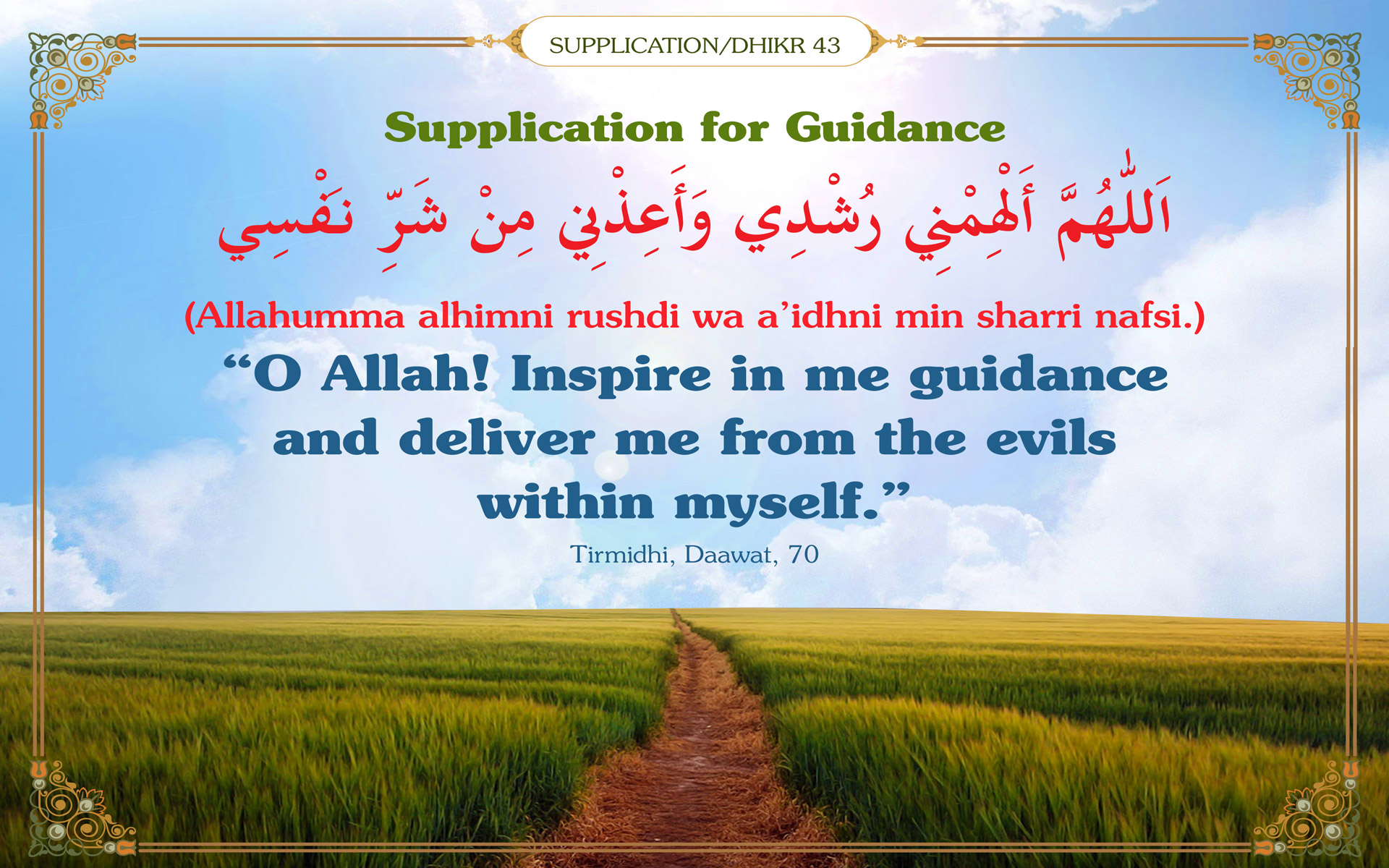
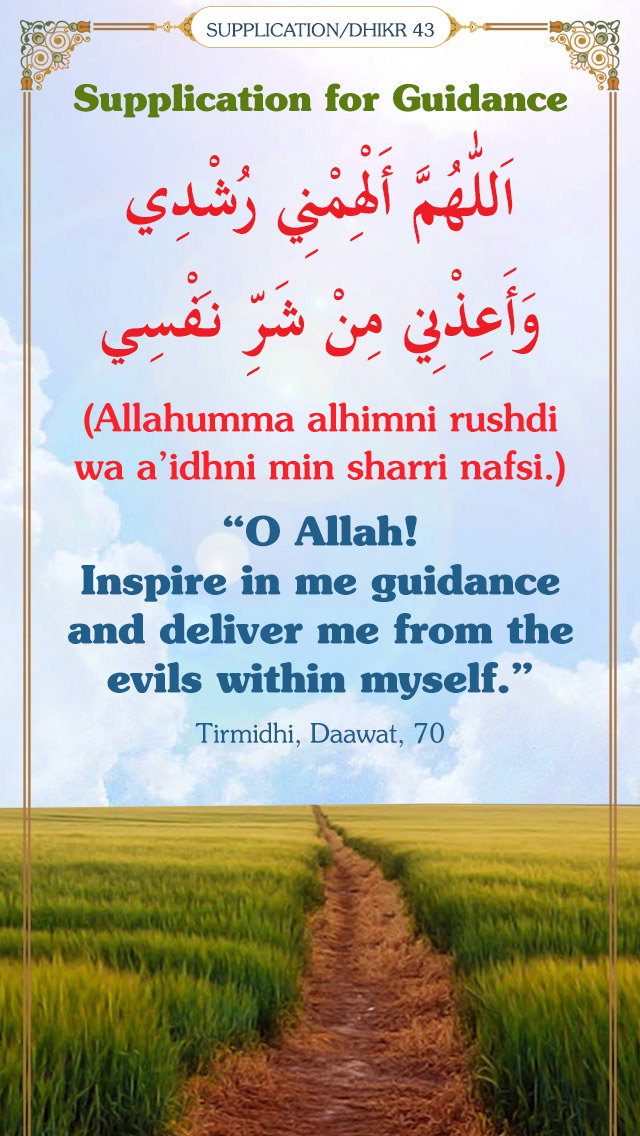
Supplication for Guidance
اَللّٰهُمَّ أَلْهِمْنِي رُشْدِي وَأَعِذْنِي مِنْ شَرِّ نَفْسِي
(Allahumma alhimni rushdi wa a’idhni min sharri nafsi.)
“O Allah! Inspire in me guidance
and deliver me from the evils within myself.”
Tirmidhi, Daawat, 70
Download (556.35 KB)

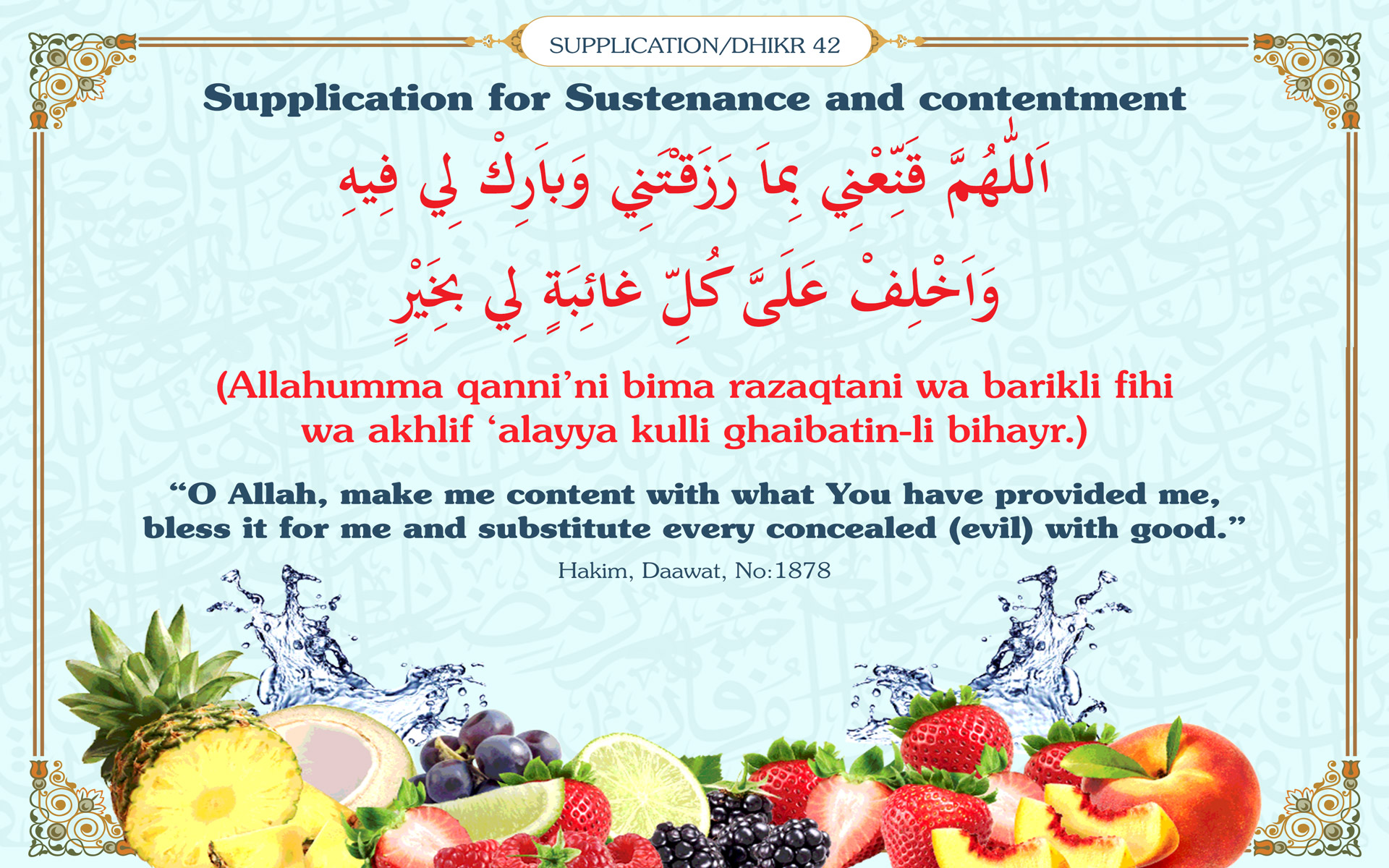
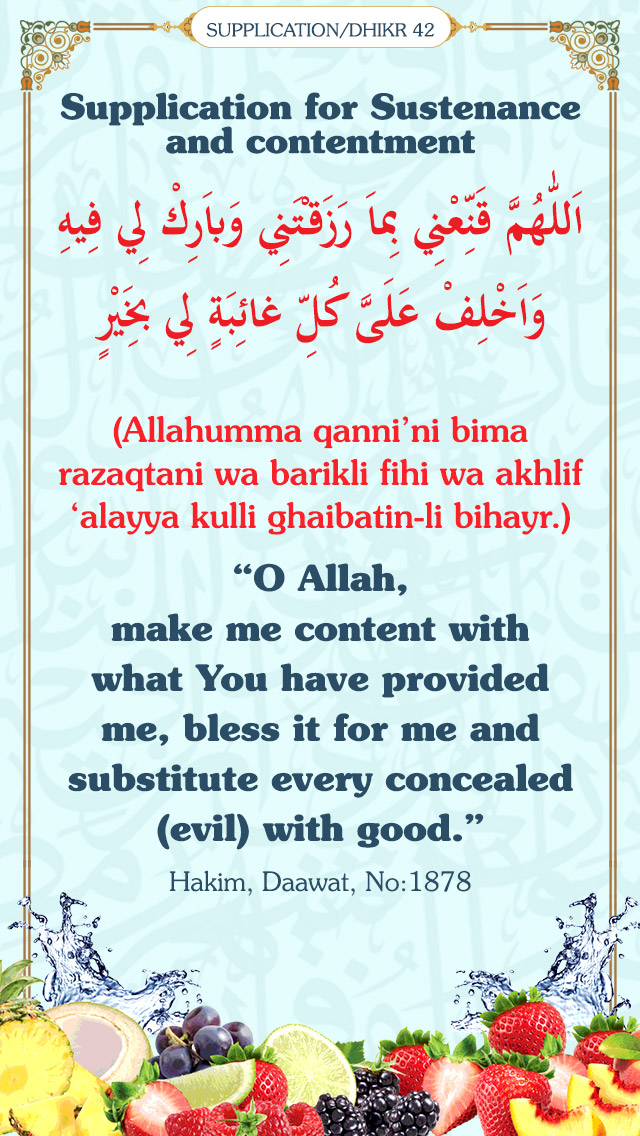
Supplication for Sustenance and contentment
اَللّٰهُمَّ قَنِّعْنِي بِماَ رَزَقْتَنِي وَباَرِكْ لِي فِيهِ
وَاَخْلِفْ عَلَىَّ كُلِّ غائِبَةٍ لِي بخَِيْرٍ
(Allahumma qanni’ni bima razaqtani wa barikli fihi wa akhlif ‘alayya kulli ghaibatin-li bihayr.)
“O Allah, make me content with what You have provided me, bless it for me and substitute every concealed (evil) with good.”
Hakim, Daawat, No:1878
Download (624.08 KB)

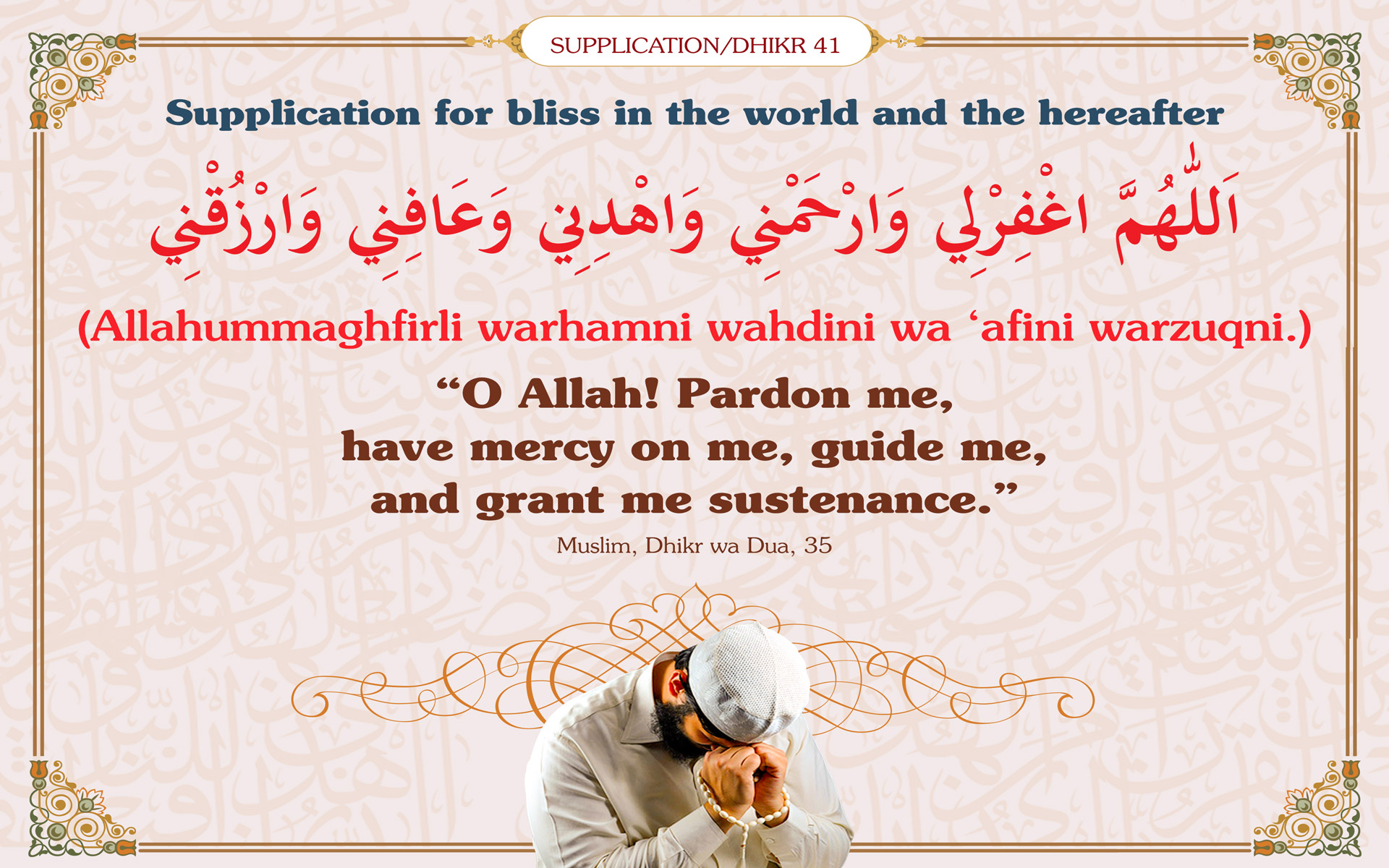
Supplication for bliss in the world and the hereafter
اَللّٰهُمَّ اغْفِرْلِي وَارْحَمْنِي وَاهْدِنِي وَعَافِنِي وَارْزُقْنِي
(Allahummaghfirli warhamni wahdini wa ‘afini warzuqni.)
“O Allah! Pardon me, have mercy on me, guide me, and grant me sustenance.”
Muslim, Dhikr wa Dua, 35
Download (541.19 KB)

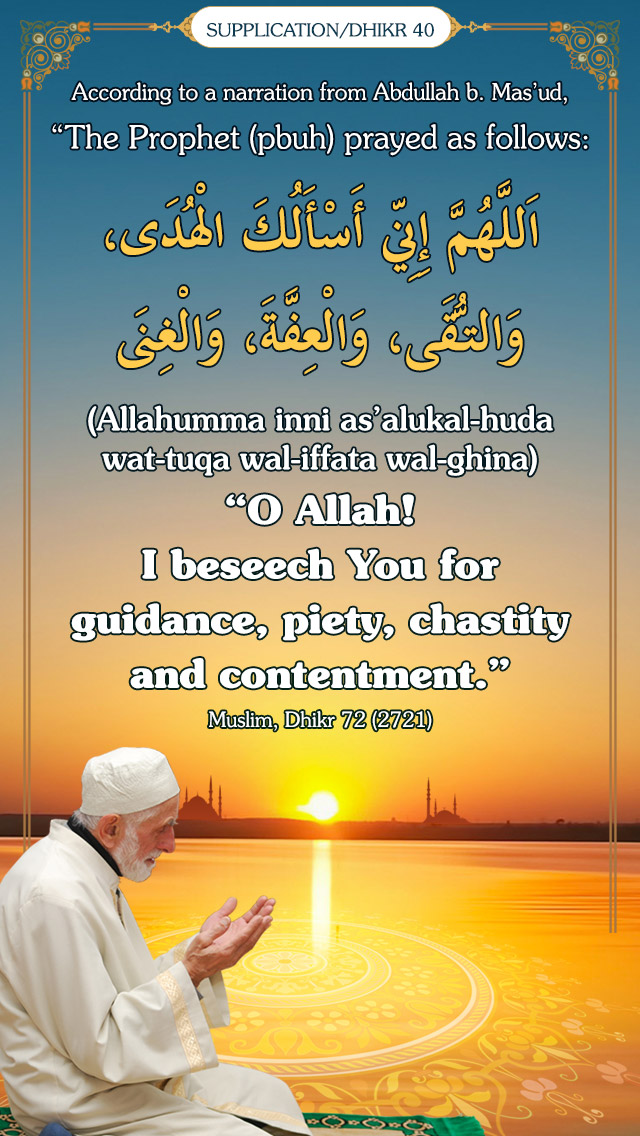
According to a narration from Abdullah b. Mas’ud,
“The Prophet (pbuh) prayed as follows:
اَللَّهُمَّ إِنِّي أَسْأَلُكَ الْهُدَى، وَالتُّقَى، وَالْعِفَّةَ، وَالْغِنَى
(Allahumma inni as’alukal-huda wat-tuqa wal-iffata wal-ghina)
“O Allah! I beseech You for guidance, piety, chastity and contentment.’”
Muslim, Dhikr 72 (2721)
Download (519.38 KB)

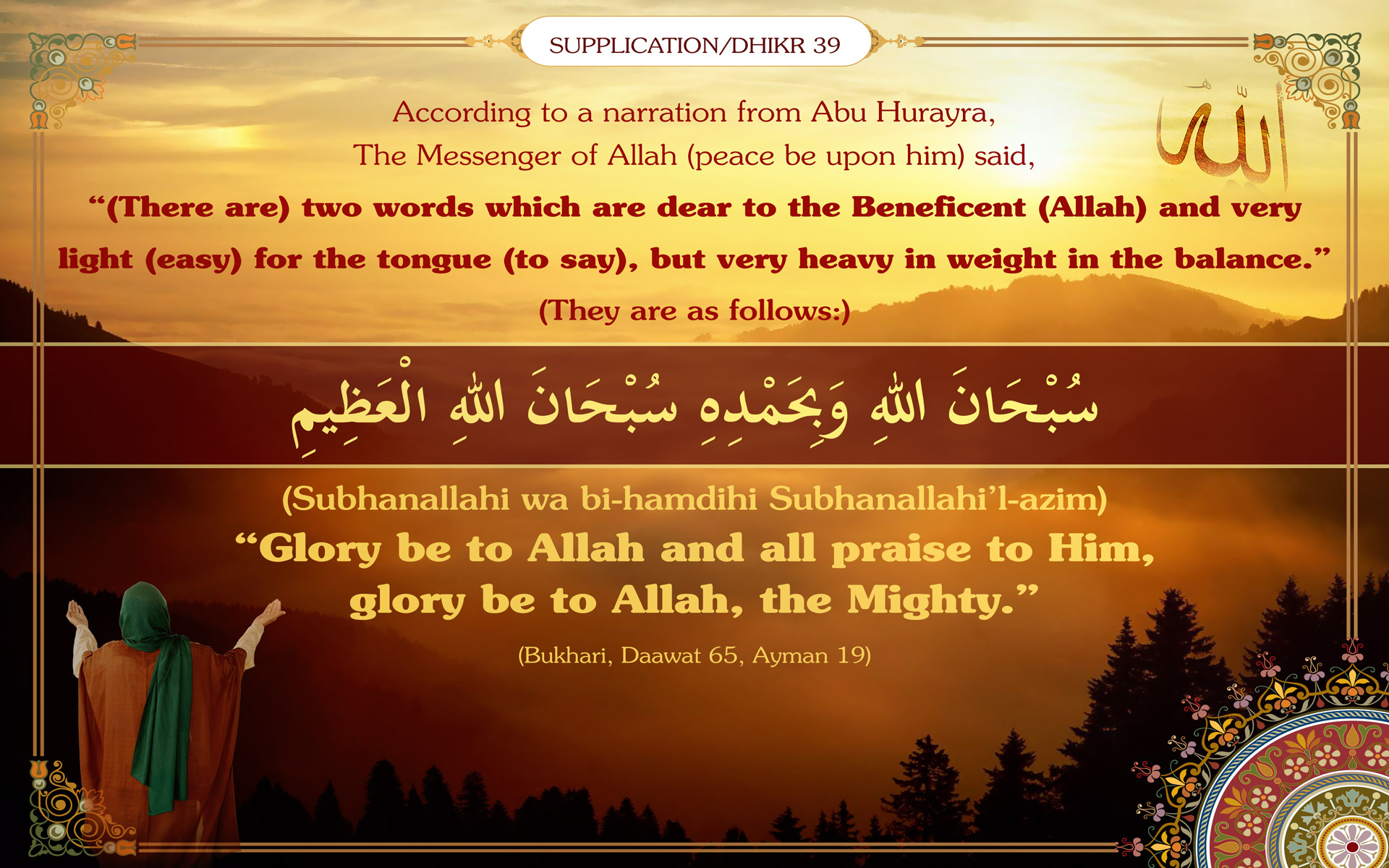
According to a narration from Abu Hurayra,
The Messenger of Allah (peace be upon him) said,
“(There are) two words which are dear to the Beneficent (Allah) and very light (easy) for the tongue (to say), but very heavy in weight in the balance.”
(They are as follows:)
سُبْحَانَ اللهِ وَبِحَمْدِهِ سُبْحَانَ اللهِ الْعَظِيمِ
(Subhanallahi wa bi-hamdihi Subhanallahi’l-azim)
“Glory be to Allah and all praise to Him, glory be to Allah, the Mighty.”
(Bukhari, Daawat 65, Ayman 19)
Download (496.34 KB)

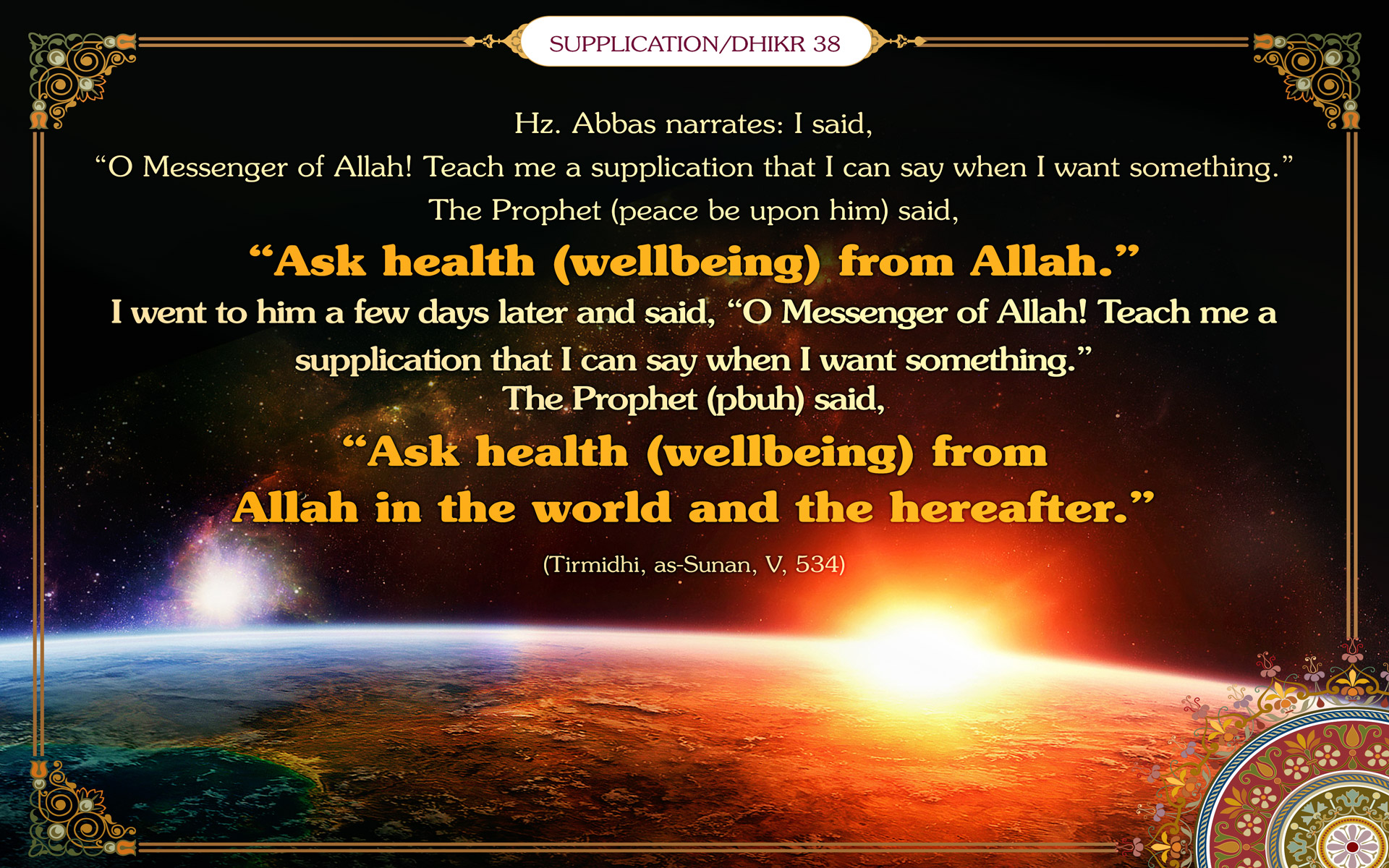
Hz. Abbas narrates: I said,
“O Messenger of Allah! Teach me a supplication that I can say when I want something.”
The Prophet (peace be upon him) said,
“Ask health (wellbeing) from Allah.”
I went to him a few days later and said, “O Messenger of Allah! Teach me a supplication that I can say when I want something.”
The Prophet (pbuh) said,
“Ask health (wellbeing) from Allah in the world and the hereafter.”
(Tirmidhi, as-Sunan, V, 534)
Download (718.62 KB)

Muadh b. Jabal narrates the following:
Two men fought and cursed each other in the presence of the Prophet (peace be upon him). When signs of fury started to appear in one of them, the Messenger of Allah (peace be upon him) said,
“I know a word. If he says it, his fury will definitely fade away:”
أَعُوذُ بِاللَّهِ مِنَ الشَّيْطَانِ الرَّجِيمِ
(Audhu billahi minash-shaytanir-rajim)
“I take refuge in Allah from Satan who was expelled from Allah’s mercy.”
(Bukhari, al-Jamius-Sahih, VIII, 19)
Download (555.76 KB)

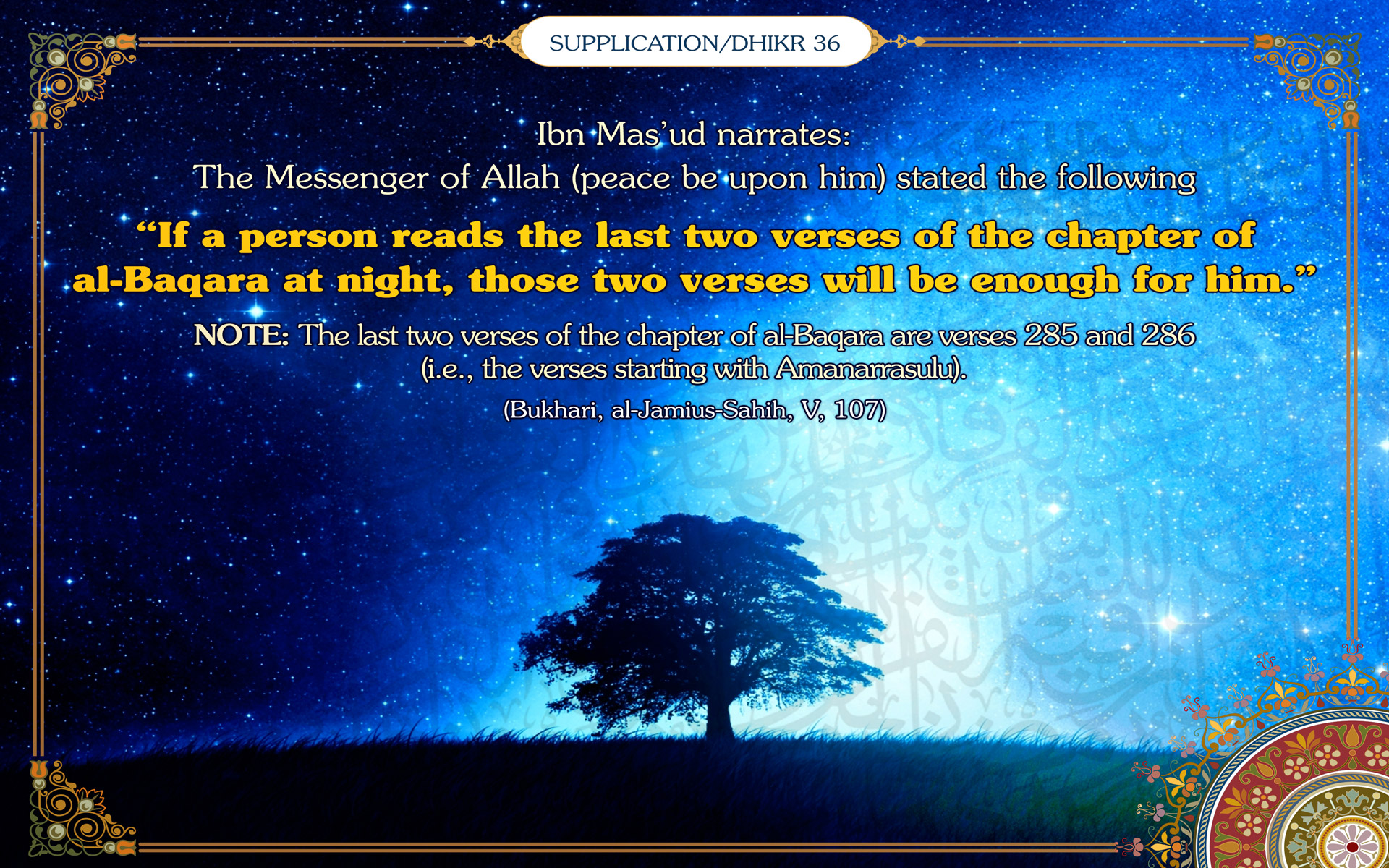
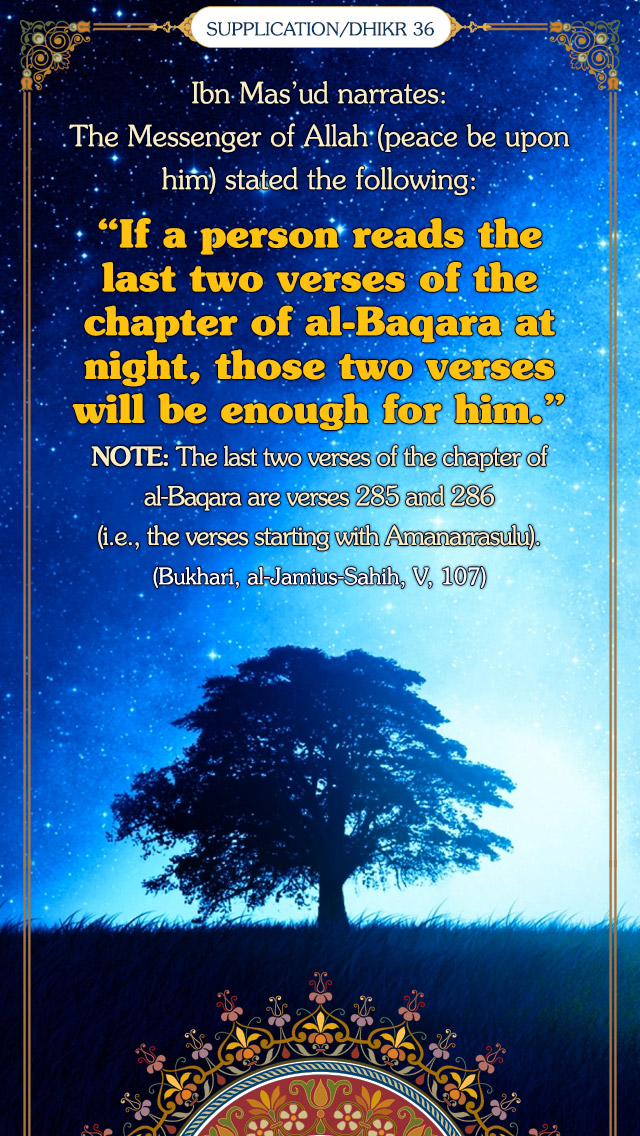
Ibn Mas’ud narrates:
The Messenger of Allah (peace be upon him) stated the following:
“If a person reads the last two verses of the chapter of al-Baqara at night, those two verses will be enough for him.”
NOTE: The last two verses of the chapter of al-Baqara are verses 285 and 286 (i.e., the verses starting with Amanarrasulu).
(Bukhari, al-Jamius-Sahih, V, 107)
Download (880.83 KB)

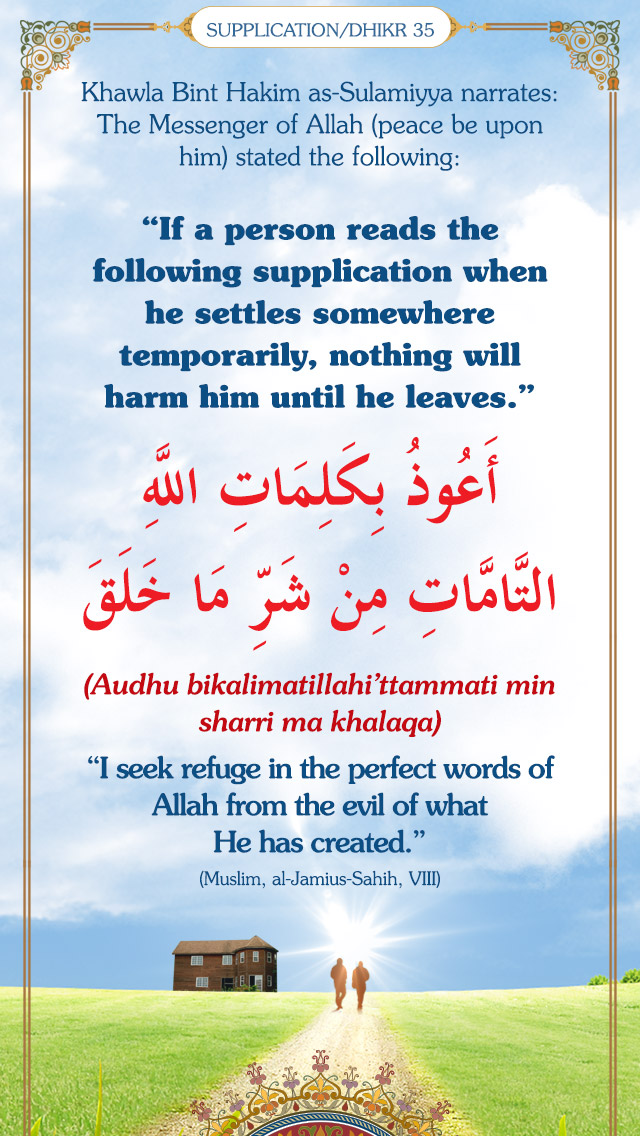
Khawla Bint Hakim as-Sulamiyya narrates:
The Messenger of Allah (peace be upon him) stated the following:
“If a person reads the following supplication when he settles somewhere temporarily, nothing will harm him until he leaves.”
أَعُوذُ بِكَلِمَاتِ اللَّهِ التَّامَّاتِ مِنْ شَرِّ مَا خَلَقَ
(Audhu bikalimatillahi’ttammati min sharri ma khalaqa)
“I seek refuge in the perfect words of Allah from the evil of what He has created.”
(Muslim, al-Jamius-Sahih, VIII)
Download (638.73 KB)

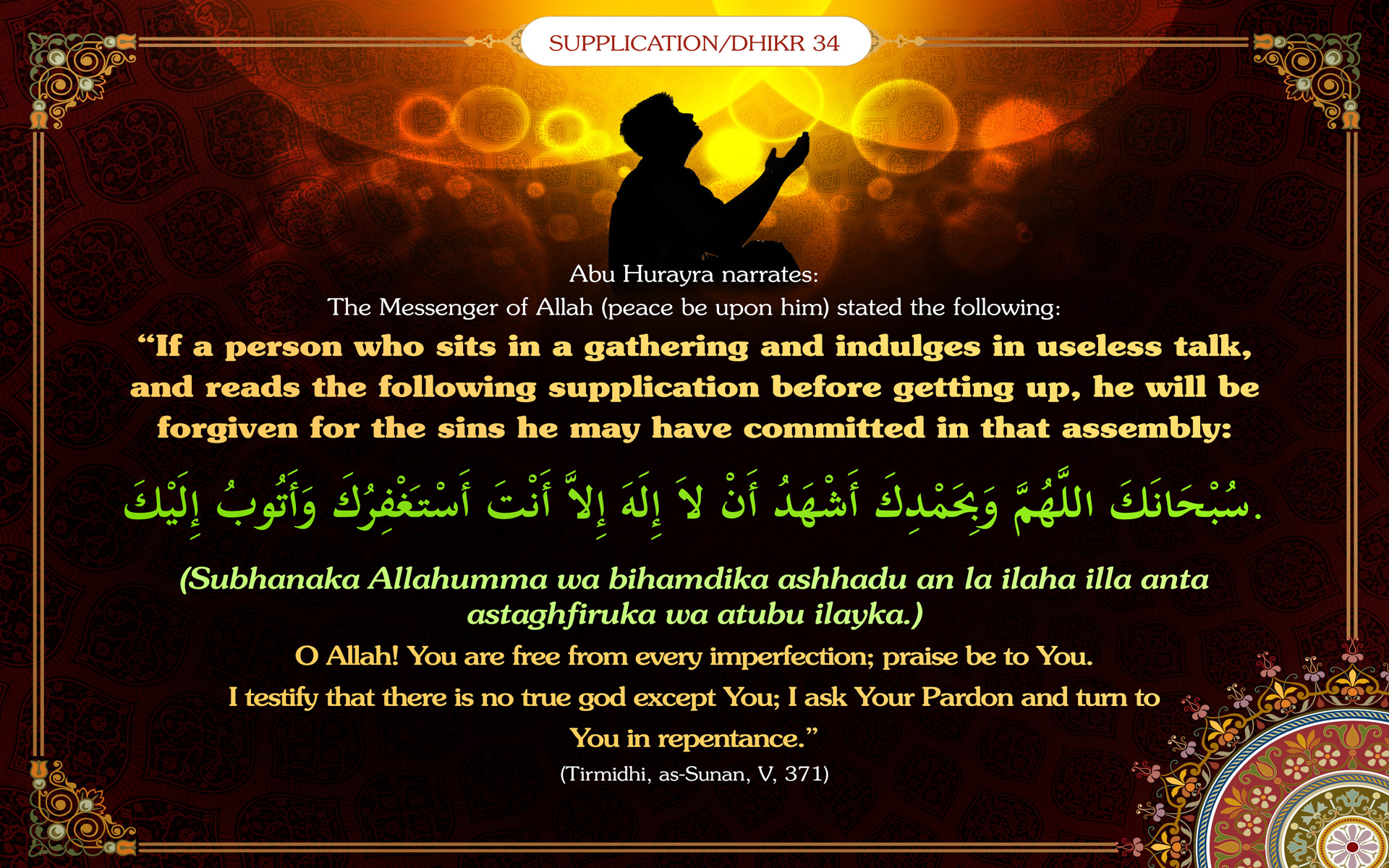
Abu Hurayra narrates:
The Messenger of Allah (peace be upon him) stated the following:
“If a person who sits in a gathering and indulges in useless talk, and reads the following supplication before getting up, he will be forgiven for the sins he may have committed in that assembly:
سُبْحَانَكَ اللَّهُمَّ وَبِحَمْدِكَ أَشْهَدُ أَنْ لاَ إِلَهَ إِلاَّ أَنْتَ أَسْتَغْفِرُكَ وَأَتُوبُ إِلَيْكَ.
(Subhanaka Allahumma wa bihamdika ashhadu an la ilaha illa anta astaghfiruka wa atubu ilayka.)
O Allah! You are free from every imperfection; praise be to You. I testify that there is no true god except You; I ask Your Pardon and turn to You in repentance.”
(Tirmidhi, as-Sunan, V, 371)
Download (774.35 KB)

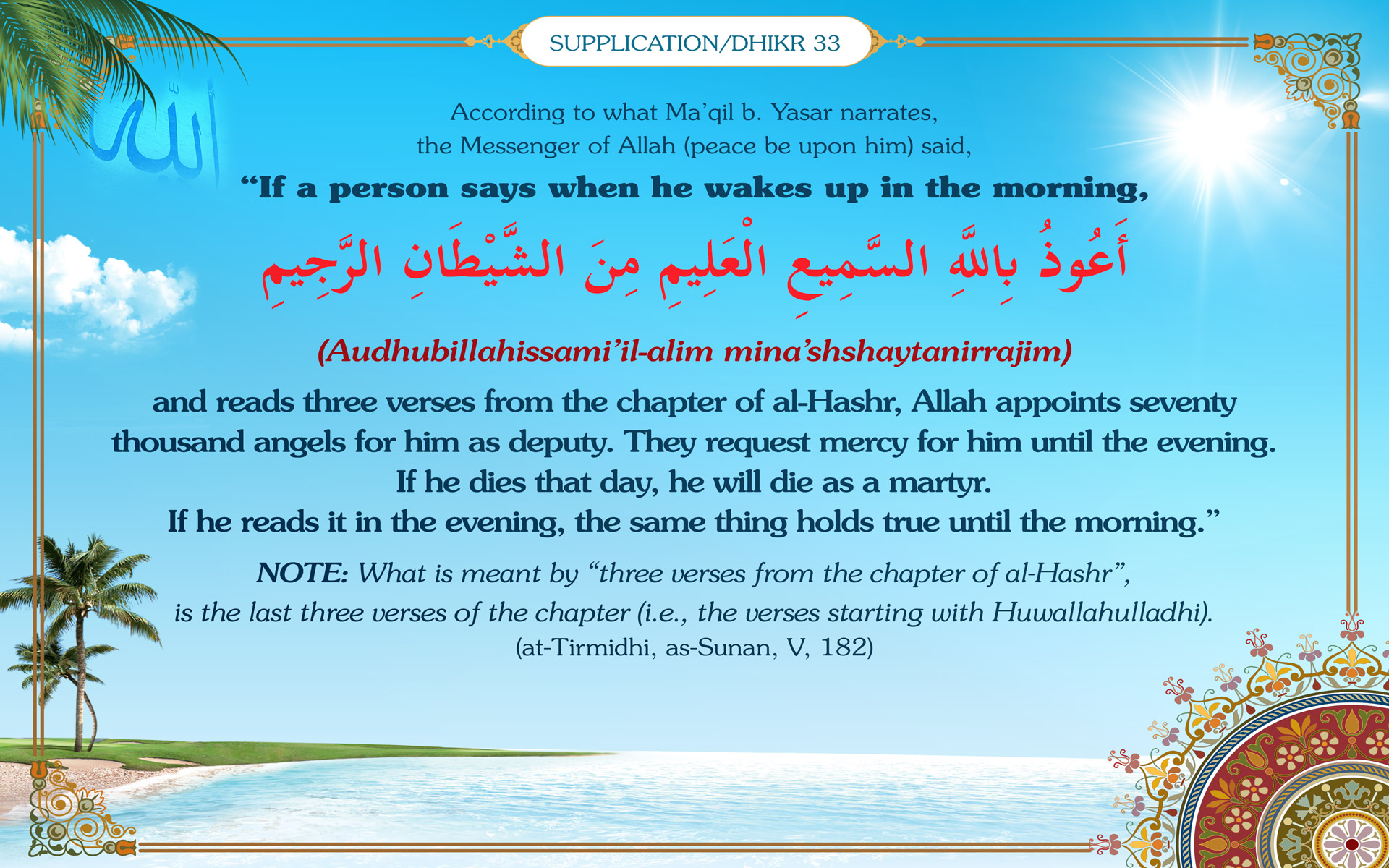
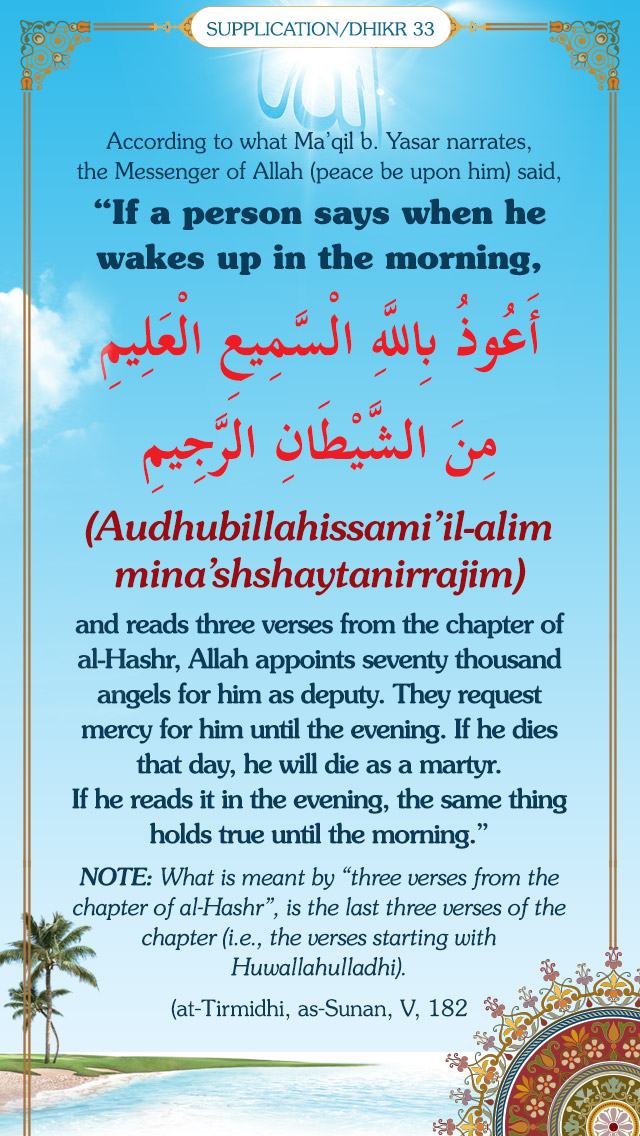
According to what Ma’qil b. Yasar narrates,
the Messenger of Allah (peace be upon him) said,
“If a person says when he wakes up in the morning,
أَعُوذُ بِاللَّهِ السَّمِيعِ الْعَلِيمِ مِنَ الشَّيْطَانِ الرَّجِيمِ
(Audhubillahissami’il-alim mina’shshaytanirrajim)
and reads three verses from the chapter of al-Hashr, Allah appoints seventy thousand angels for him as deputy. They request mercy for him until the evening. If he dies that day, he will die as a martyr.
If he reads it in the evening, the same thing holds true until the morning.”
NOTE: What is meant by “three verses from the chapter of al-Hashr”, is the last three verses of the chapter (i.e., the verses starting with Huwallahulladhi).
(at-Tirmidhi, as-Sunan, V, 182)
Download (606.53 KB)

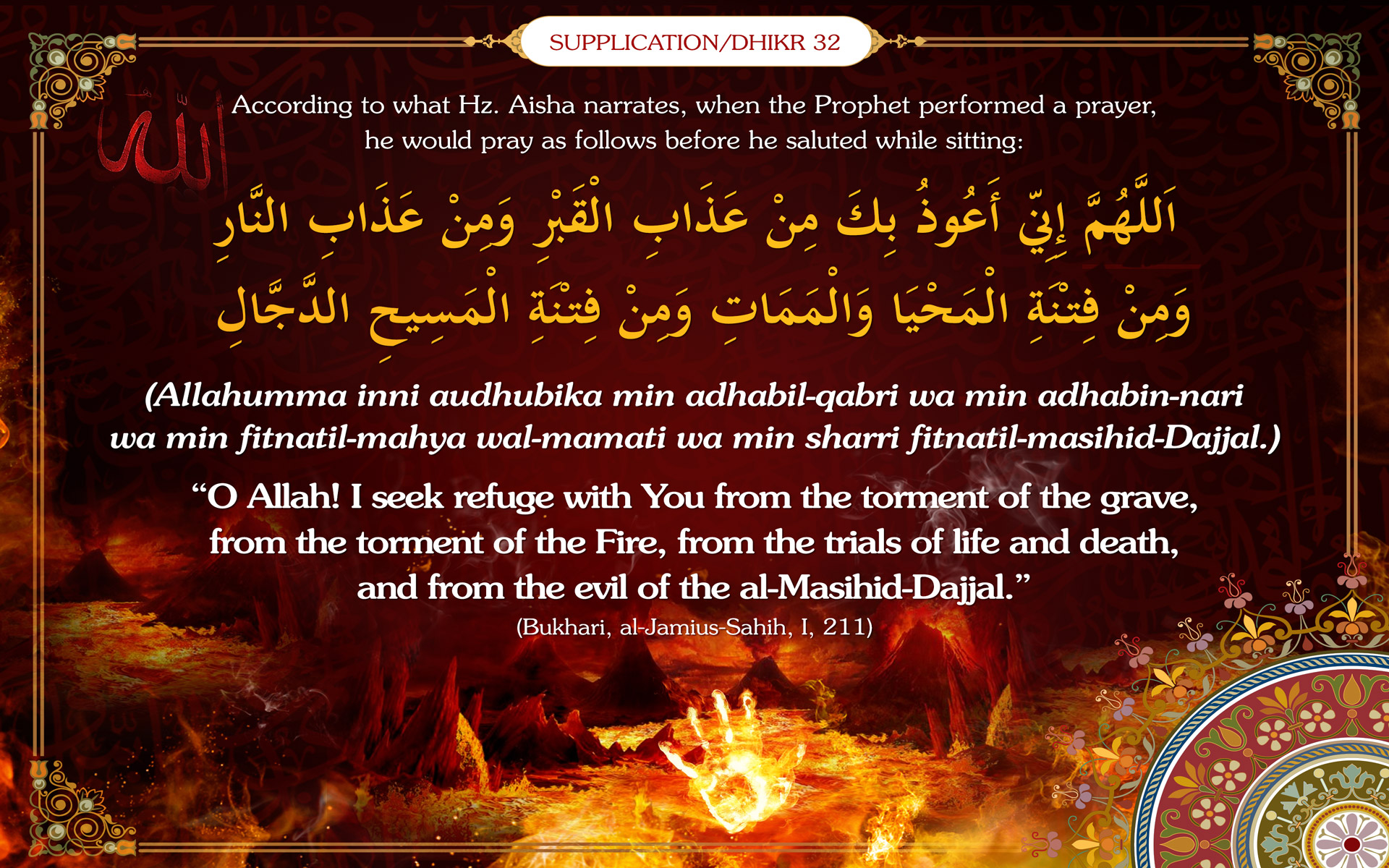
According to what Hz. Aisha narrates, when the Prophet performed a prayer, he would pray as follows before he saluted while sitting:
اَللَّهُمَّ إِنِّي أَعُوذُ بِكَ مِنْ عَذَابِ الْقَبْرِ وَمِنْ عَذَابِ النَّارِ
وَمِنْ فِتْنَةِ الْمَحْيَا وَالْمَمَاتِ وَمِنْ فِتْنَةِ الْمَسِيحِ الدَّجَّالِ
(Allahumma inni audhubika min adhabil-qabri wa min adhabin-nari wa min fitnatil-mahya wal-mamati wa min sharri fitnatil-masihid-Dajjal.)
“O Allah! I seek refuge with You from the torment of the grave, from the torment of the Fire, from the trials of life and death, and from the evil of the al-Masihid-Dajjal.”
(Bukhari, al-Jamius-Sahih, I, 211)
Download (745.49 KB)

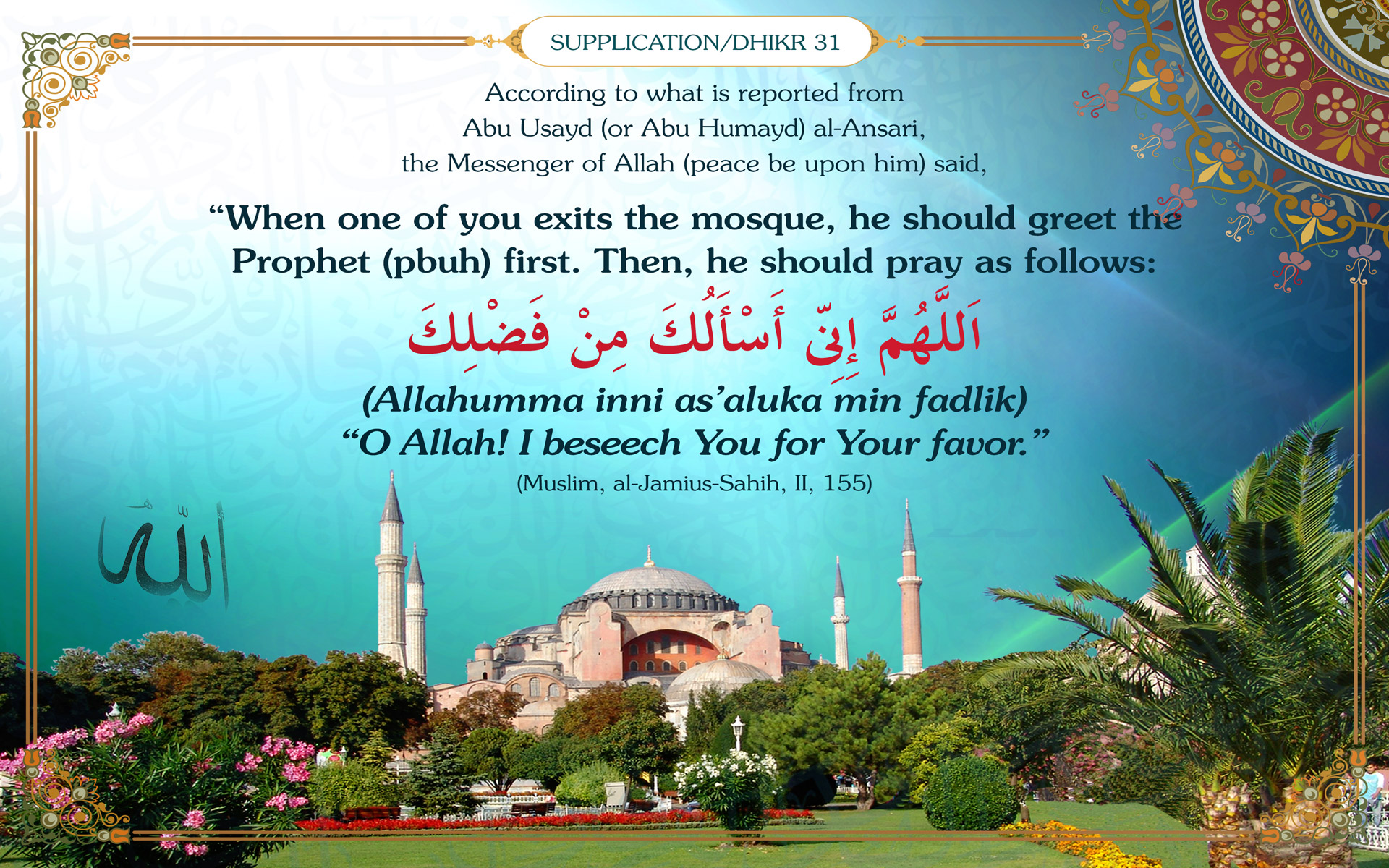
According to what is reported from Abu Usayd (or Abu Humayd) al-Ansari,
the Messenger of Allah (peace be upon him) said,
“When one of you exits the mosque, he should greet the Prophet (pbuh) first. Then, he should pray as follows:
اَللَّهُمَّ إِنِّى أَسْأَلُكَ مِنْ فَضْلِكَ
(Allahumma inni as’aluka min fadlik)
“O Allah! I beseech You for Your favor.”
(Muslim, al-Jamius-Sahih, II, 155)
Download (761.89 KB)

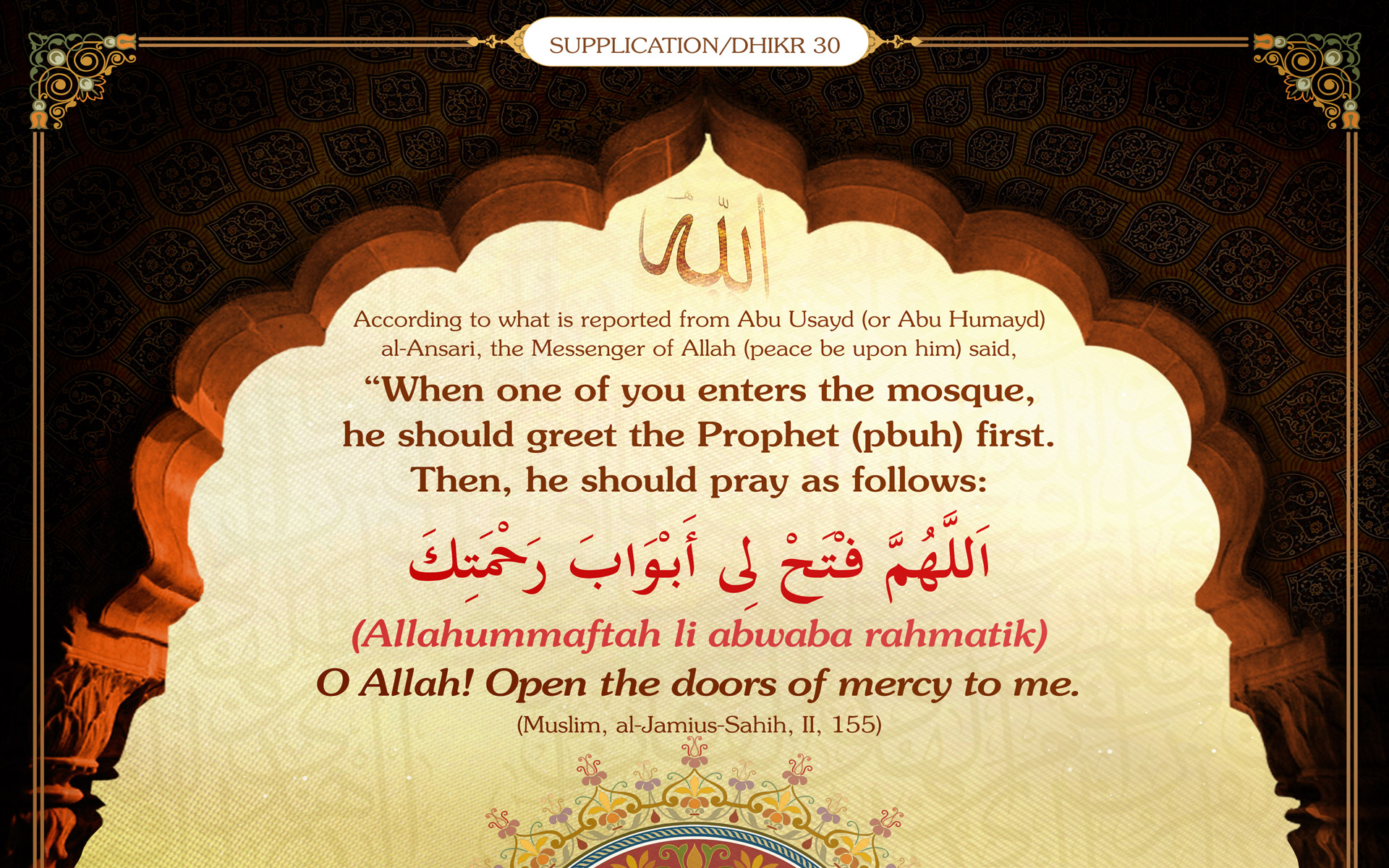
According to what is reported from Abu Usayd (or Abu Humayd) al-Ansari, the Messenger of Allah (peace be upon him) said,
“When one of you enters the mosque, he should greet the Prophet (pbuh) first.
Then, he should pray as follows:
اَللَّهُمَّ فْتَحْ لِى أَبْوَابَ رَحْمَتِكَ
(Allahummaftah li abwaba rahmatik)
O Allah! Open the doors of mercy to me.
(Muslim, al-Jamius-Sahih, II, 155)
Download (771.69 KB)

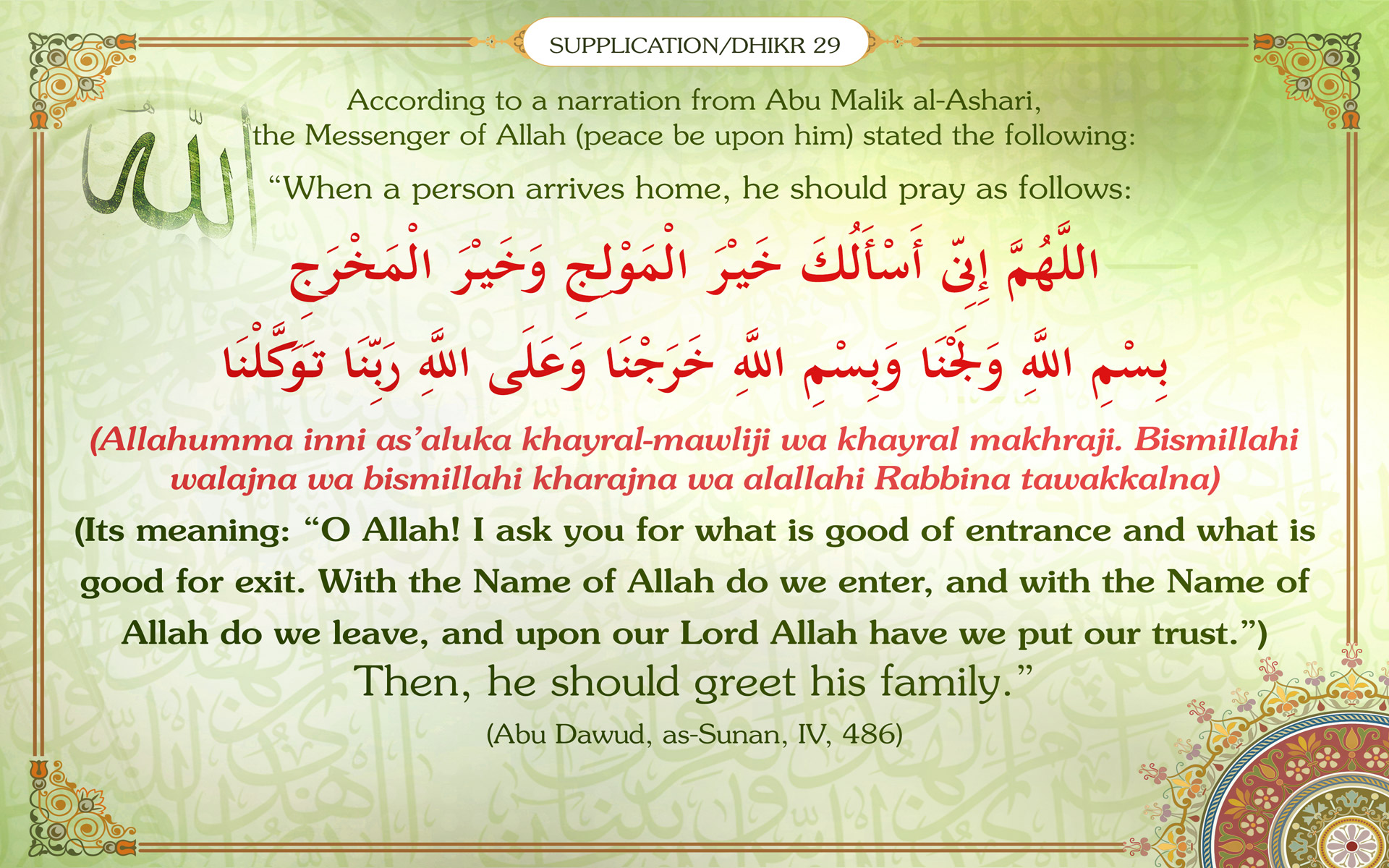
According to a narration from Abu Malik al-Ashari,
the Messenger of Allah (peace be upon him) stated the following:
“When a person arrives home, he should pray as follows:
اللَّهُمَّ إِنِّى أَسْأَلُكَ خَيْرَ الْمَوْلِجِ وَخَيْرَ الْمَخْرَجِ
بِسْمِ اللَّهِ وَلَجْنَا وَبِسْمِ اللَّهِ خَرَجْنَا وَعَلَى اللَّهِ رَبِّنَا تَوَكَّلْنَا
(Allahumma inni as’aluka khayral-mawliji wa khayral makhraji. Bismillahi walajna wa bismillahi kharajna wa alallahi Rabbina tawakkalna)
(Its meaning: “O Allah! I ask you for what is good of entrance and what is good for exit. With the Name of Allah do we enter, and with the Name of Allah do we leave, and upon our Lord Allah have we put our trust.”) Then, he should greet his family.”
(Abu Dawud, as-Sunan, IV, 486)
Download (639.89 KB)

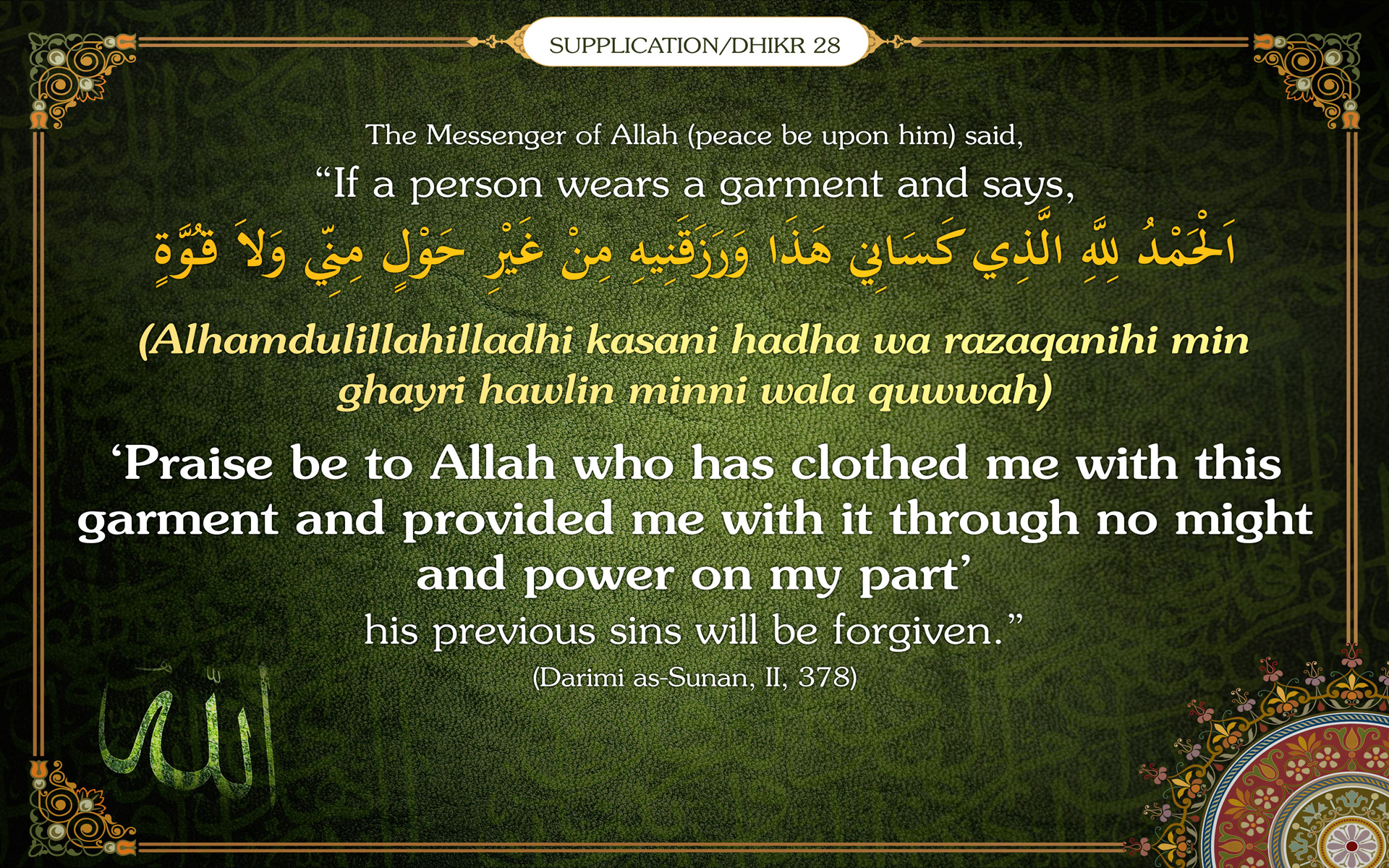
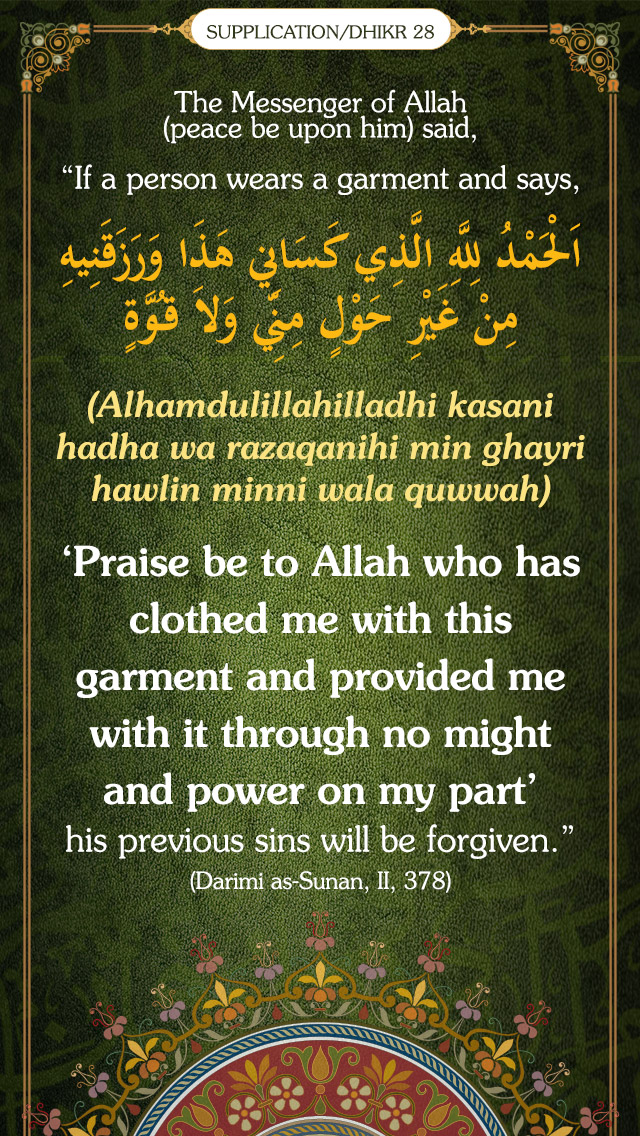
The Messenger of Allah (peace be upon him) said,
“If a person wears a garment and says,
اَلْحَمْدُ لِلَّهِ الَّذِي كَسَانِي هَذَا وَرَزَقَنِيهِ مِنْ غَيْرِ حَوْلٍ مِنِّي وَلاَ قُوَّةٍ
(Alhamdulillahilladhi kasani hadha wa razaqanihi min ghayri hawlin minni wala quwwah)
‘Praise be to Allah who has clothed me with this garment and provided me with it through no might and power on my part’
his previous sins will be forgiven.”
(Darimi as-Sunan, II, 378)
Download (1.01 MB)

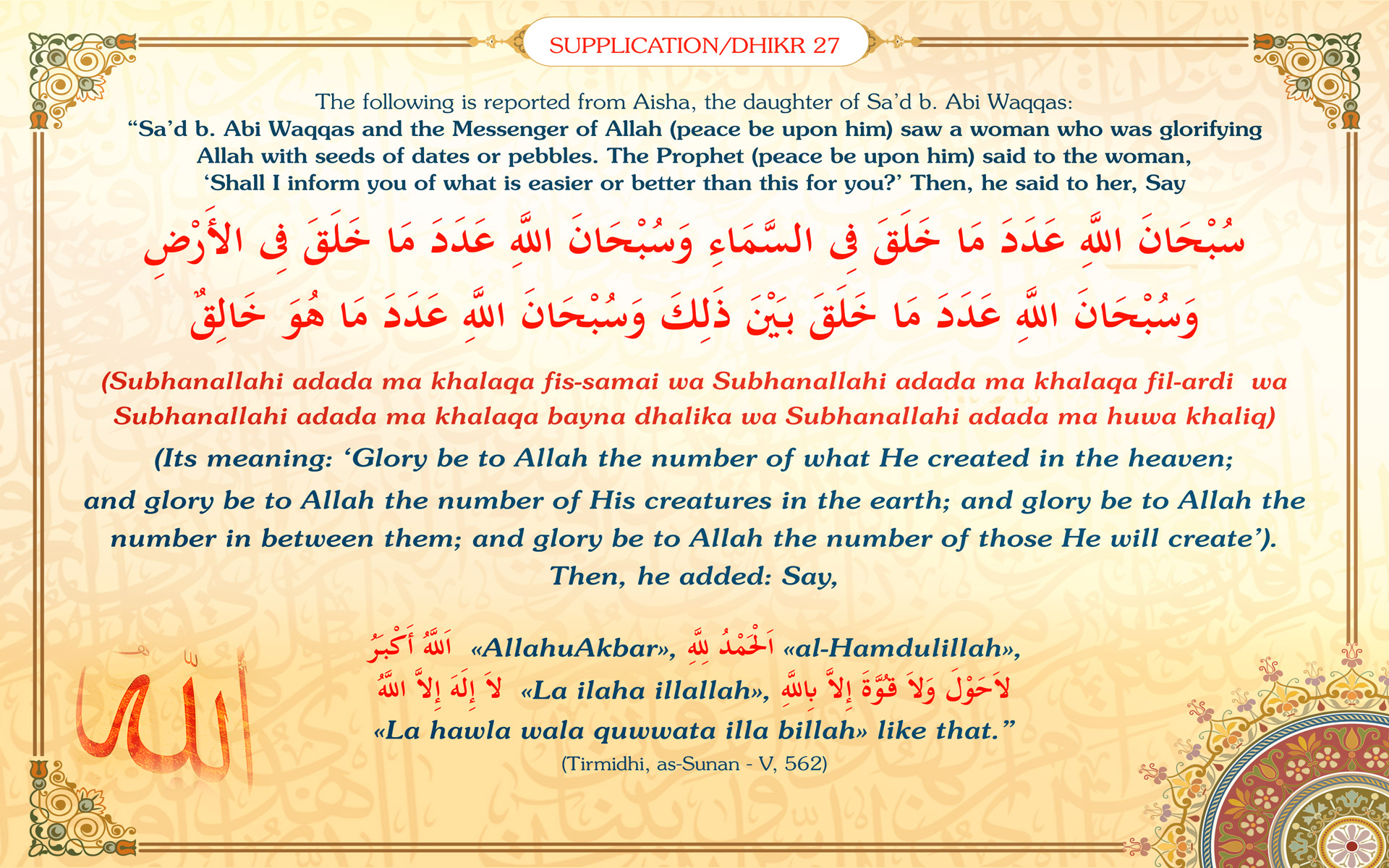
The following is reported from Aisha, the daughter of Sa’d b. Abi Waqqas:
“Sa’d b. Abi Waqqas and the Messenger of Allah (peace be upon him) saw a woman who was glorifying Allah with seeds of dates or pebbles. The Prophet (peace be upon him) said to the woman, ‘Shall I inform you of what is easier or better than this for you?’ Then, he said to her, Say
سُبْحَانَ اللَّهِ عَدَدَ مَا خَلَقَ فِى السَّمَاءِ وَسُبْحَانَ اللَّهِ عَدَدَ مَا خَلَقَ فِى الأَرْضِ
وَسُبْحَانَ اللَّهِ عَدَدَ مَا خَلَقَ بَيْنَ ذَلِكَ وَسُبْحَانَ اللَّهِ عَدَدَ مَا هُوَ خَالِقٌ
(Subhanallahi adada ma khalaqa fis-samai wa Subhanallahi adada ma khalaqa fil-ardi wa Subhanallahi adada ma khalaqa bayna dhalika wa Subhanallahi adada ma huwa khaliq)
(Its meaning: ‘Glory be to Allah the number of what He created in the heaven; and glory be to Allah the number of His creatures in the earth; and glory be to Allah the number in between them; and glory be to Allah the number of those He will create’). Then, he added: Say,
اَللَّهُ أَكْبَرُ «AllahuAkbar», اَلْحَمْدُ لِلَّهِ «al-Hamdulillah»,
لاَ إِلَهَ إِلاَّ اللَّهُ «La ilaha illallah», لاَحَوْلَ وَلاَ قُوَّةَ إِلاَّ بِاللَّهِ
«La hawla wala quwwata illa billah» like that.”
(Tirmidhi, as-Sunan - V, 562)
Download (735.66 KB)

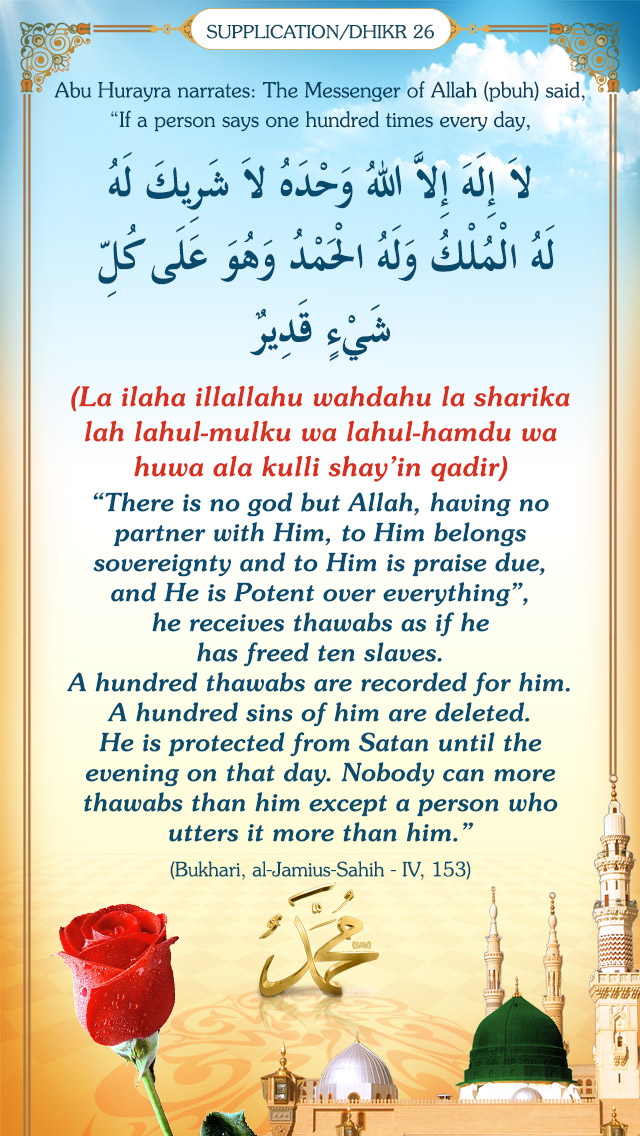
Abu Hurayra narrates: The Messenger of Allah (pbuh) said,
“If a person says one hundred times every day,
لاَ إِلَهَ إِلاَّ اللهُ وَحْدَهُ لاَ شَرِيكَ لَهُ لَهُ الْمُلْكُ وَلَهُ الْحَمْدُ وَهُوَ عَلَى كُلِّ شَيْءٍ قَدِيرِ
(La ilaha illallahu wahdahu la sharika lah lahul-mulku wa lahul-hamdu wa huwa ala kulli shay’in qadir)
“There is no god but Allah, having no partner with Him, to Him belongs sovereignty and to Him is praise due, and He is Potent over everything”, he receives thawabs as if he has freed ten slaves. A hundred thawabs are recorded for him. A hundred sins of him are deleted. He is protected from Satan until the evening on that day. Nobody can more thawabs than him except a person who utters it more than him.”
(Bukhari, al-Jamius-Sahih - IV, 153).
Download (591.99 KB)

According to what is reported from Anas b. Malik, one of the supplications that the Messenger of Allah (peace be upon him) uttered the most was as follows:
اَللَّهُمَّ رَبَّنَا آتِنَا فِي الدُّنْيَا حَسَنَةً وَفِي الآخِرَةِ حَسَنَةً وَقِنَا عَذَابَ النَّارِ
(Allahumma rabbana atina fid-dunya hasanatan wa fil-akhirati hasanah wa qina adhaban-nar)
“O Allah! Our Lord! Give us good in this world and good in the Hereafter, and defend us from the torment of the Fire!”
(Bukhari, al-Jamius-Sahih - VIII, 103).
Download (871.41 KB)

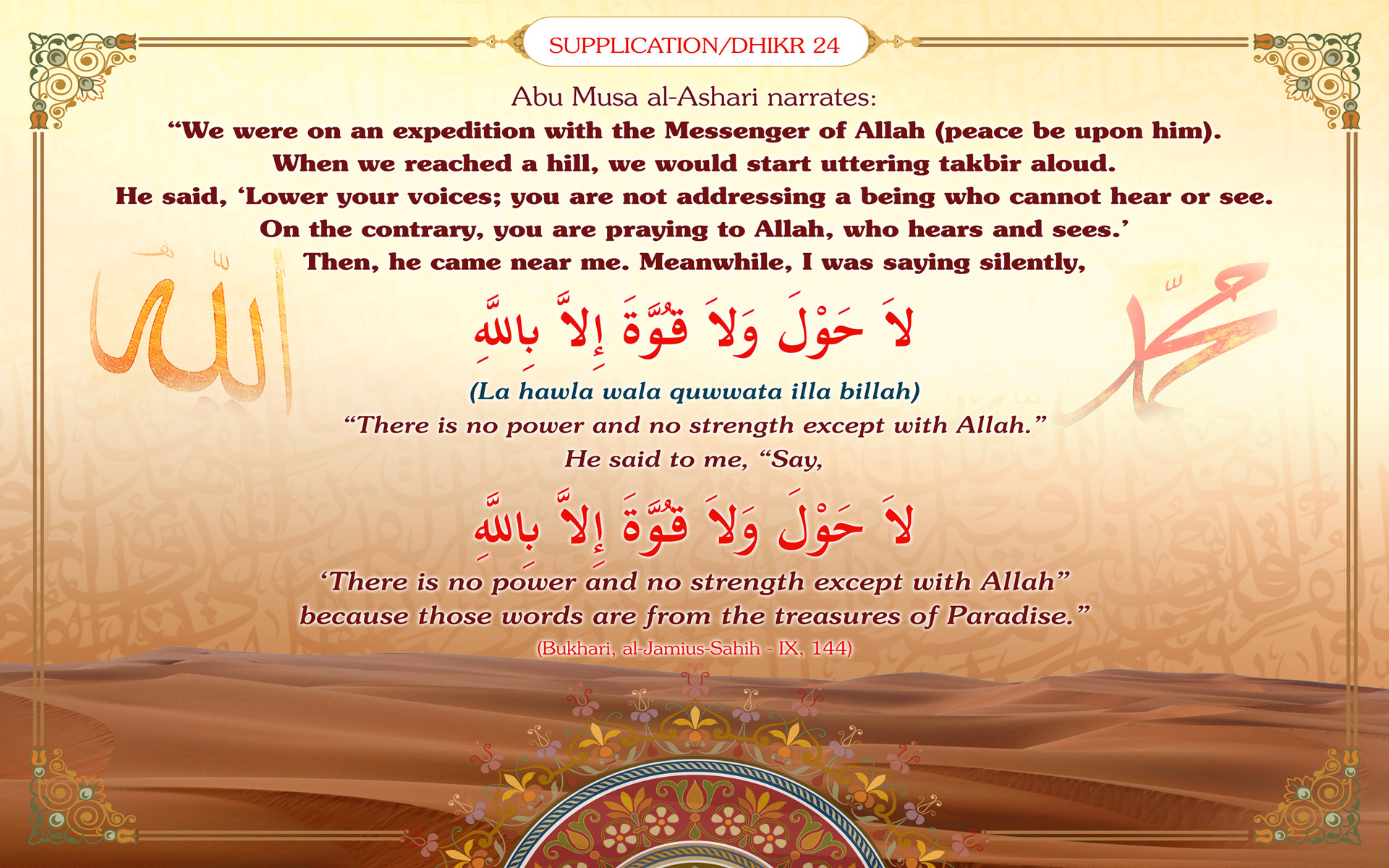
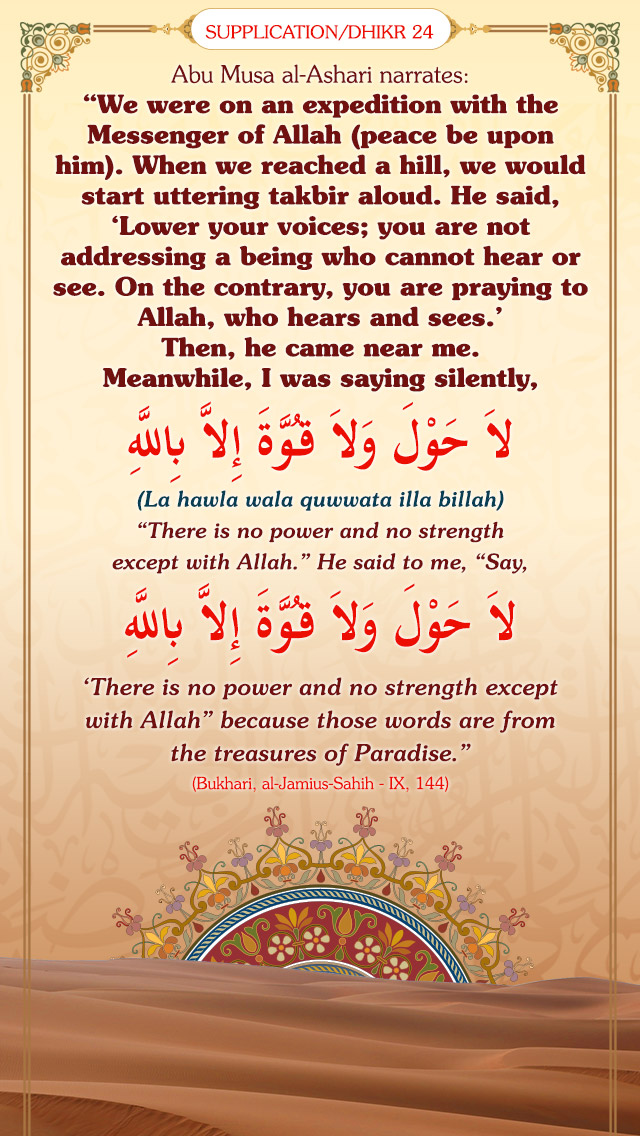
Abu Musa al-Ashari narrates:
“We were on an expedition with the Messenger of Allah (peace be upon him). When we reached a hill, we would start uttering takbir aloud. He said, ‘Lower your voices; you are not addressing a being who cannot hear or see. On the contrary, you are praying to Allah, who hears and sees.’ Then, he came near me. Meanwhile, I was saying silently,
لاَ حَوْلَ وَلاَ قُوَّةَ إِلاَّ بِاللَّهِ
(La hawla wala quwwata illa billah)
“There is no power and no strength except with Allah.” He said to me, “Say,
لاَ حَوْلَ وَلاَ قُوَّةَ إِلاَّ بِاللَّهِ
‘There is no power and no strength except with Allah” because those words are from the treasures of Paradise.”
(Bukhari, al-Jamius-Sahih - IX, 144)
Download (583.11 KB)

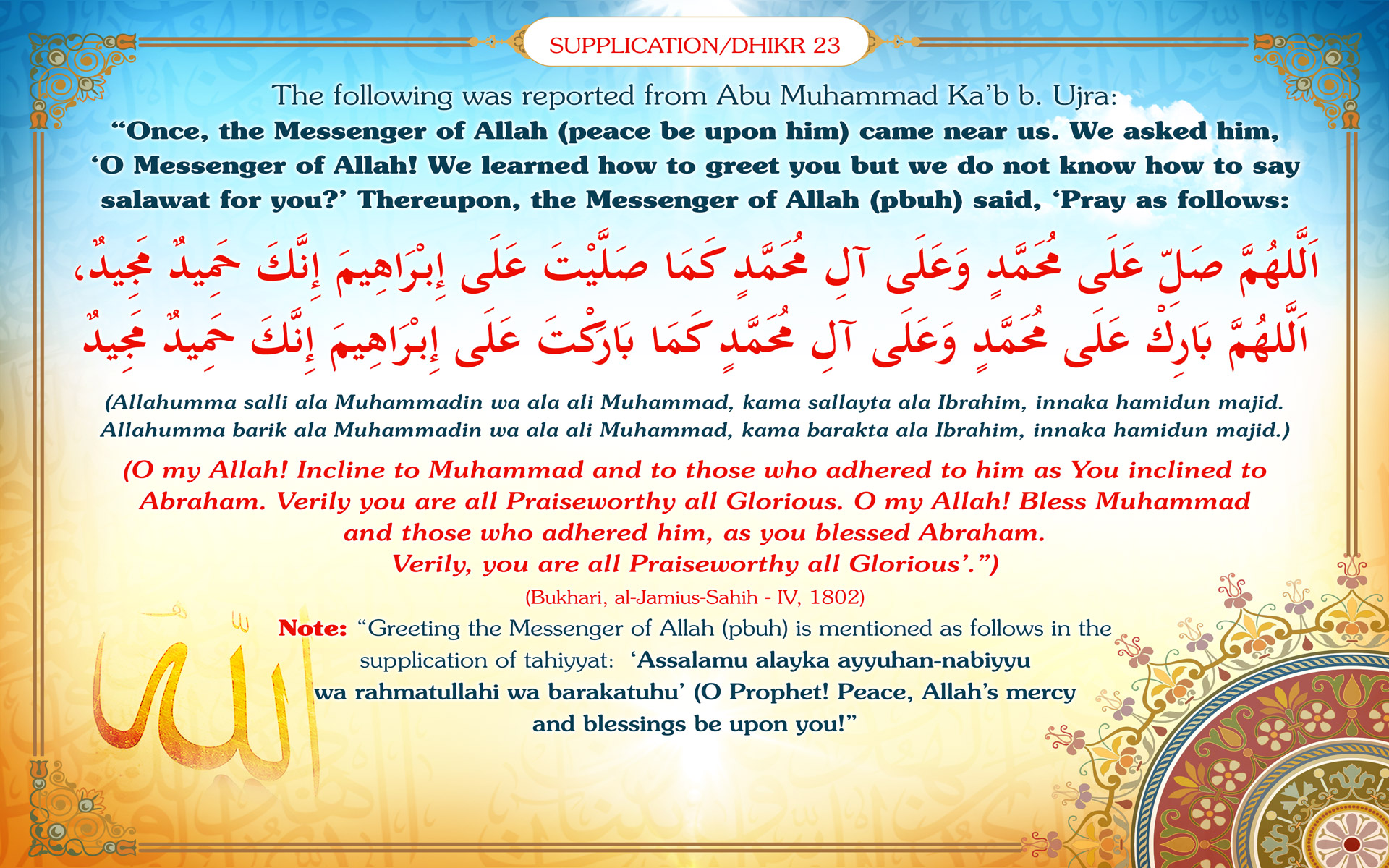
The following was reported from Abu Muhammad Ka’b b. Ujra:
“Once, the Messenger of Allah (peace be upon him) came near us. We asked him,
‘O Messenger of Allah! We learned how to greet you but we do not know how to say salawat for you?’ Thereupon, the Messenger of Allah (pbuh) said, ‘Pray as follows:
اَلَّلهُمَّ صَلِّ عَلَى مُحَمَّدٍ وَعَلَى آلِ مُحَمَّدٍ كَمَا صَلَّيْتَ عَلَى إِبْرَاهِيمَ إِنَّكَ حَمِيدٌ مَجِيدٌ، اَلَّلهُمَّ بَارِكْ عَلَى مُحَمَّدٍ وَعَلَى آلِ مُحَمَّدٍ كَمَا بَارَكْتَ عَلَى إِبْرَاهِيمَ إِنَّكَ حَمِيدٌ مَجِيدٌ
(Allahumma salli ala Muhammadin wa ala ali Muhammad, kama sallayta ala Ibrahim, innaka hamidun majid. Allahumma barik ala Muhammadin wa ala ali Muhammad, kama barakta ala Ibrahim, innaka hamidun majid.)
(O my Allah! Incline to Muhammad and to those who adhered to him as You inclined to Abraham. Verily you are all Praiseworthy all Glorious. O my Allah! Bless Muhammad and those who adhered him, as you blessed Abraham. Verily, you are all Praiseworthy all Glorious’.”)
(Bukhari, al-Jamius-Sahih - IV, 1802)
Note: “Greeting the Messenger of Allah (pbuh) is mentioned as follows in the supplication of tahiyyat: ‘Assalamu alayka ayyuhan-nabiyyu wa rahmatullahi wa barakatuhu’ (O Prophet! Peace, Allah’s mercy and blessings be upon you!”
Download (756.69 KB)

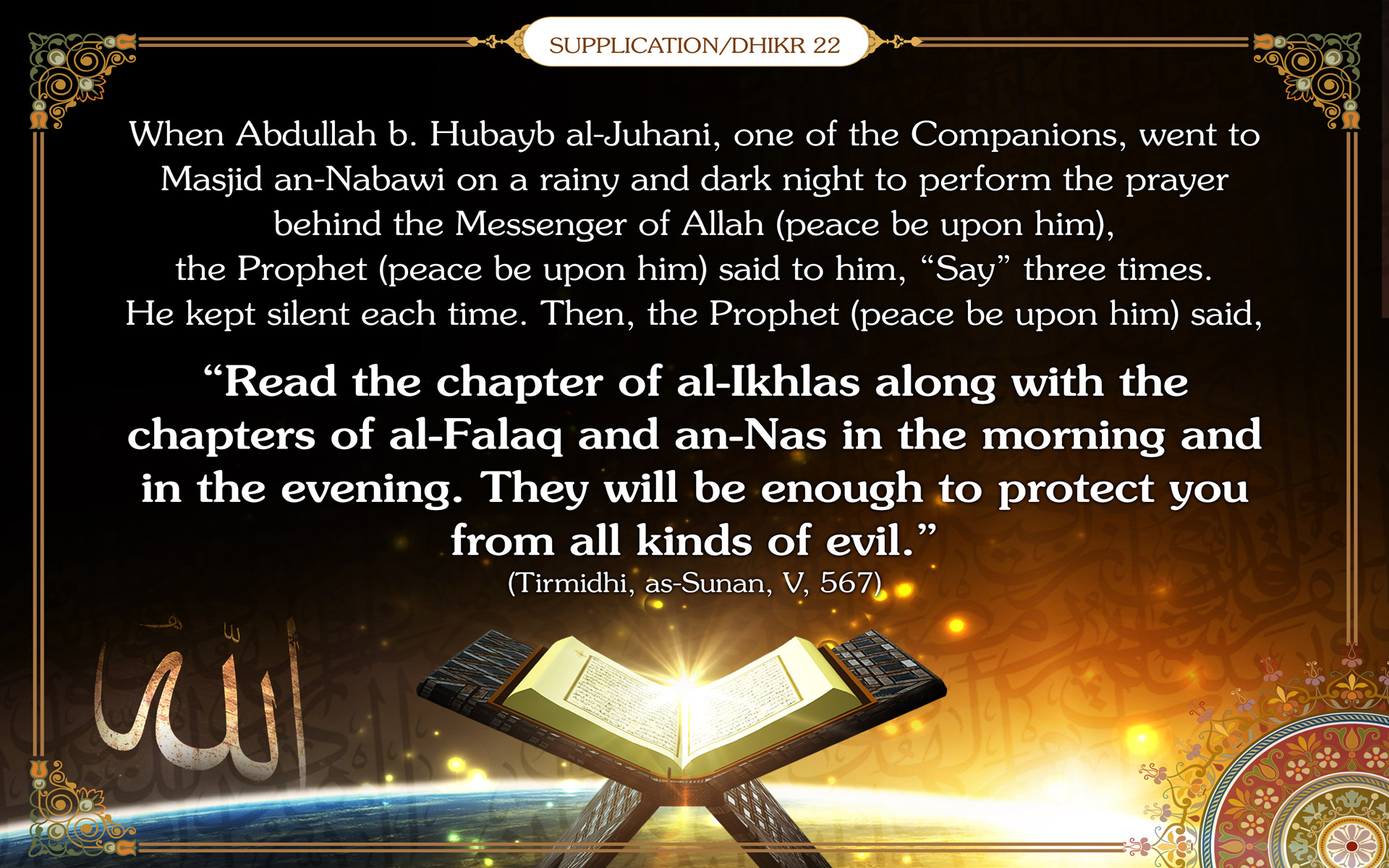
When Abdullah b. Hubayb al-Juhani, one of the Companions, went to Masjid an-Nabawi on a rainy and dark night to perform the prayer behind the Messenger of Allah (peace be upon him), the Prophet (peace be upon him) said to him, “Say” three times. He kept silent each time. Then, the Prophet (peace be upon him) said,
“Read the chapter of al-Ikhlas along with the chapters of al-Falaq and an-Nas in the morning and in the evening. They will be enough to protect you from all kinds of evil.”
(Tirmidhi, as-Sunan, V, 567)
Download (552.58 KB)

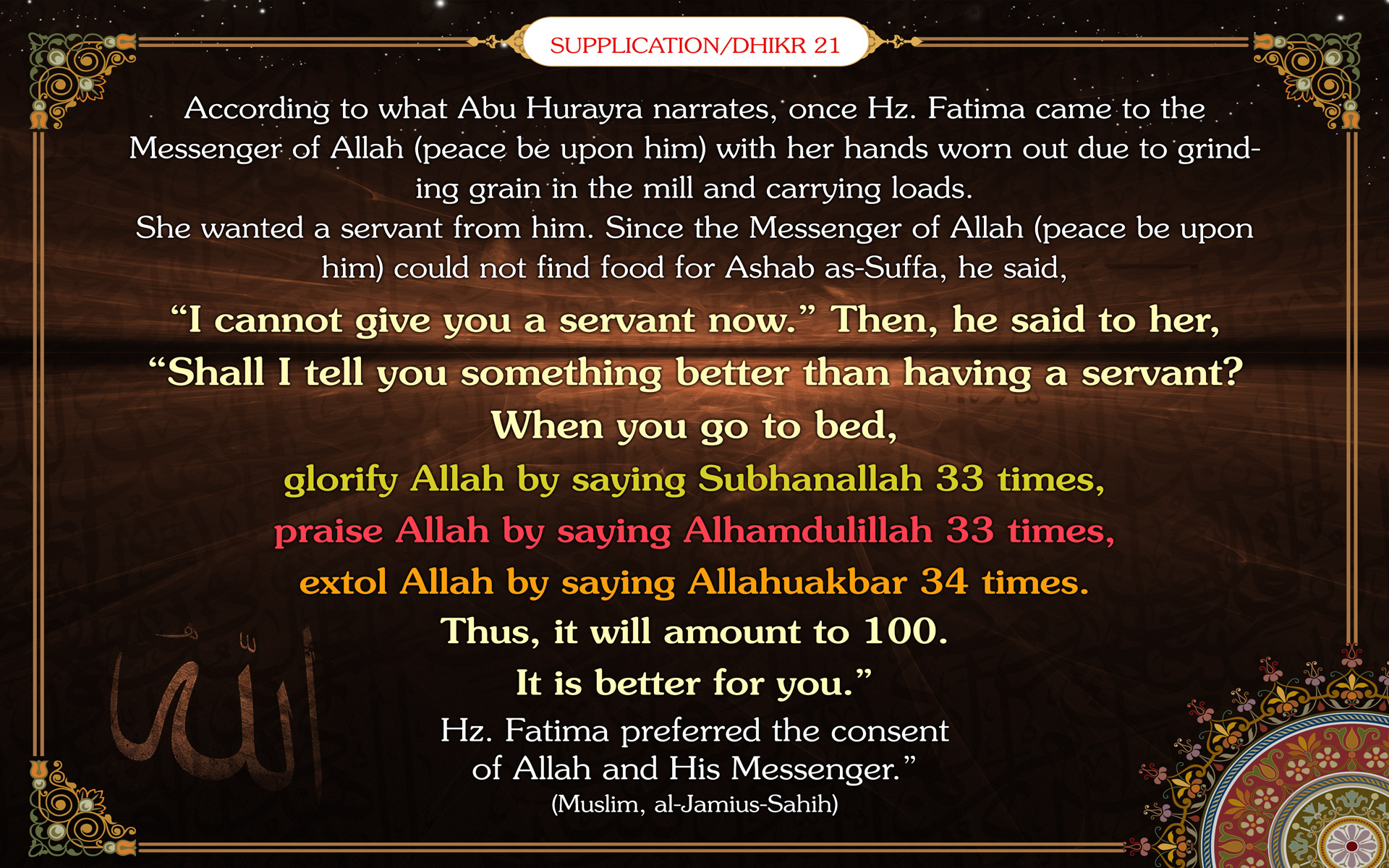
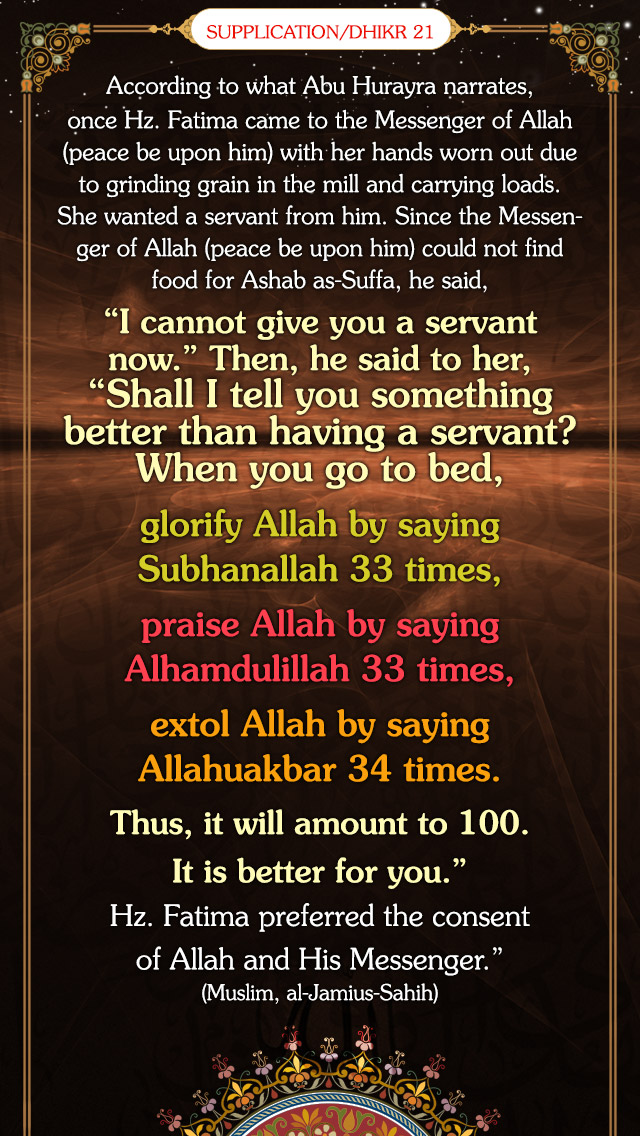
According to what Abu Hurayra narrates, once Hz. Fatima came to the Messenger of Allah (peace be upon him) with her hands worn out due to grinding grain in the mill and carrying loads.
She wanted a servant from him. Since the Messenger of Allah (peace be upon him) could not find food for Ashab as-Suffa, he said,
“İ cannot give you a servant now.” Then, he said to her,
“Shall I tell you something better than having a servant? When you go to bed,
glorify Allah by saying Subhanallah 33 times,
praise Allah by saying Alhamdulillah 33 times,
extol Allah by saying Allahuakbar 34 times.
Thus, it will amount to 100.
It is better for you.”
Hz. Fatima preferred the consent of Allah and His Messenger.”
(Muslim, al-Jamius-Sahih)
Download (647.34 KB)

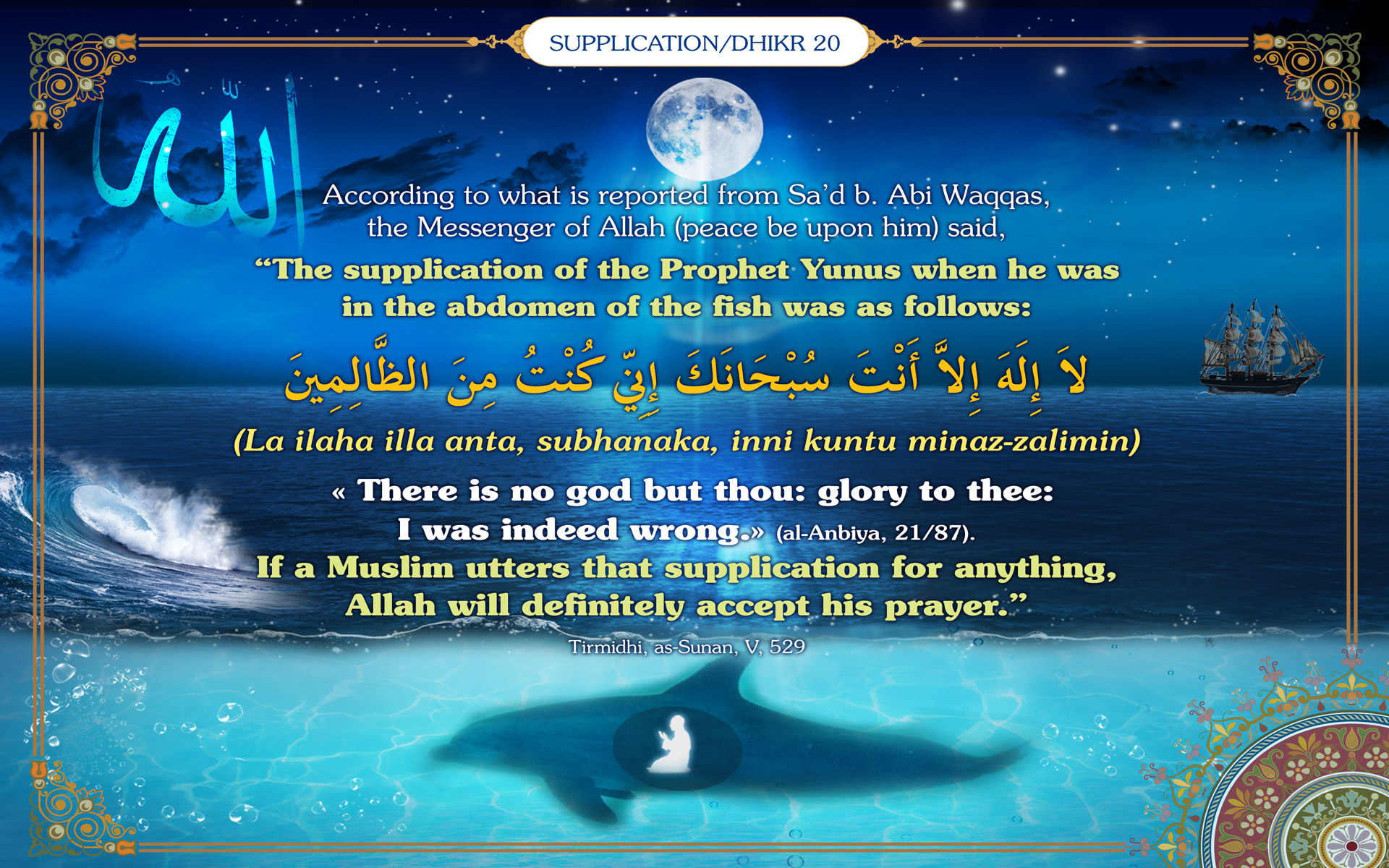
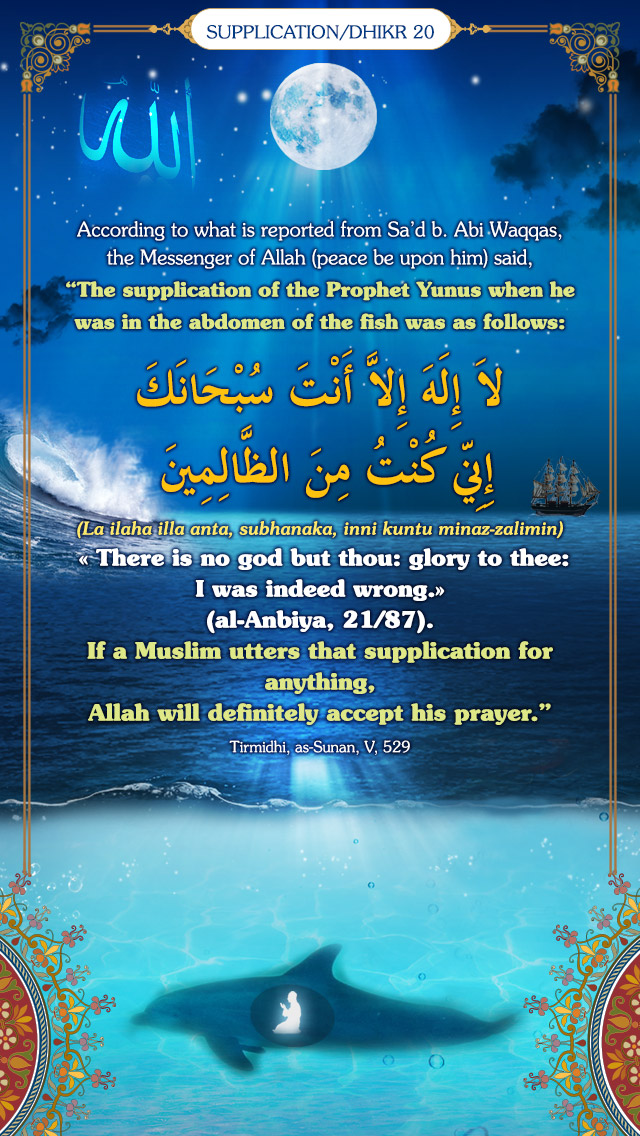
According to what is reported from Sa’d b. Abi Waqqas,
the Messenger of Allah (peace be upon him) said,
“The supplication of the Prophet Yunus when he was in the abdomen of the fish was as follows:
لاَ إِلَهَ إِلاَّ أَنْتَ سُبْحَانَكَ إِنِّي كُنْتُ مِنَ الظَّالِمِينَ
(La ilaha illa anta, subhanaka, inni kuntu minaz-zalimin)
« There is no god but thou: glory to thee:
I was indeed wrong.» (al-Anbiya, 21/87).
If a Muslim utters that supplication for anything,
Allah will definitely accept his prayer.”
Tirmidhi, as-Sunan, V, 529
Download (714.15 KB)

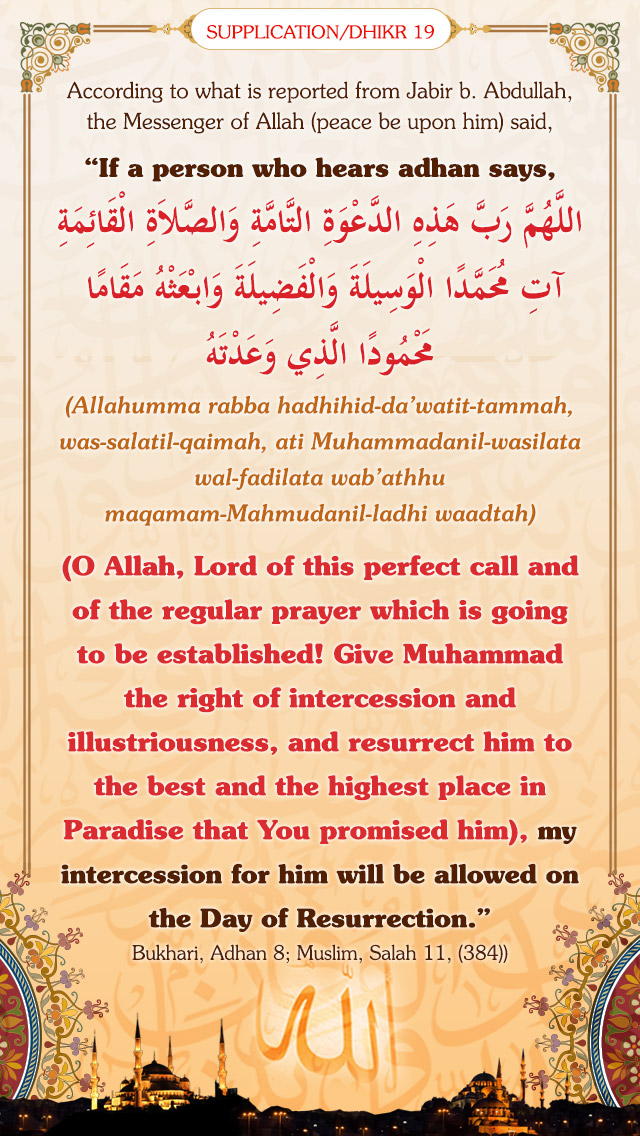
According to what is reported from Jabir b. Abdullah, the Messenger of Allah (peace be upon him) said,
“If a person who hears adhan says,
اللَّهُمَّ رَبَّ هَذِهِ الدَّعْوَةِ التَّامَّةِ وَالصَّلاَةِ الْقَائِمَةِ
آتِ مُحَمَّدًا الْوَسِيلَةَ وَالْفَضِيلَةَ وَابْعَثْهُ مَقَامًا مَحْمُودًا الَّذِي وَعَدْتَهُ
(Allahumma rabba hadhihid-da’watit-tammah, was-salatil-qaimah, ati Muhammadanil-wasilata wal-fadilata wab’athhu maqamam-Mahmudanil-ladhi waadtah)
(O Allah, Lord of this perfect call and of the regular prayer which is going to be established! Give Muhammad the right of intercession and illustriousness, and resurrect him to the best and the highest place in Paradise that You promised him), my intercession for him will be allowed on the Day of Resurrection.”
Bukhari, Adhan 8; Muslim, Salah 11, (384))
Download (625.77 KB)

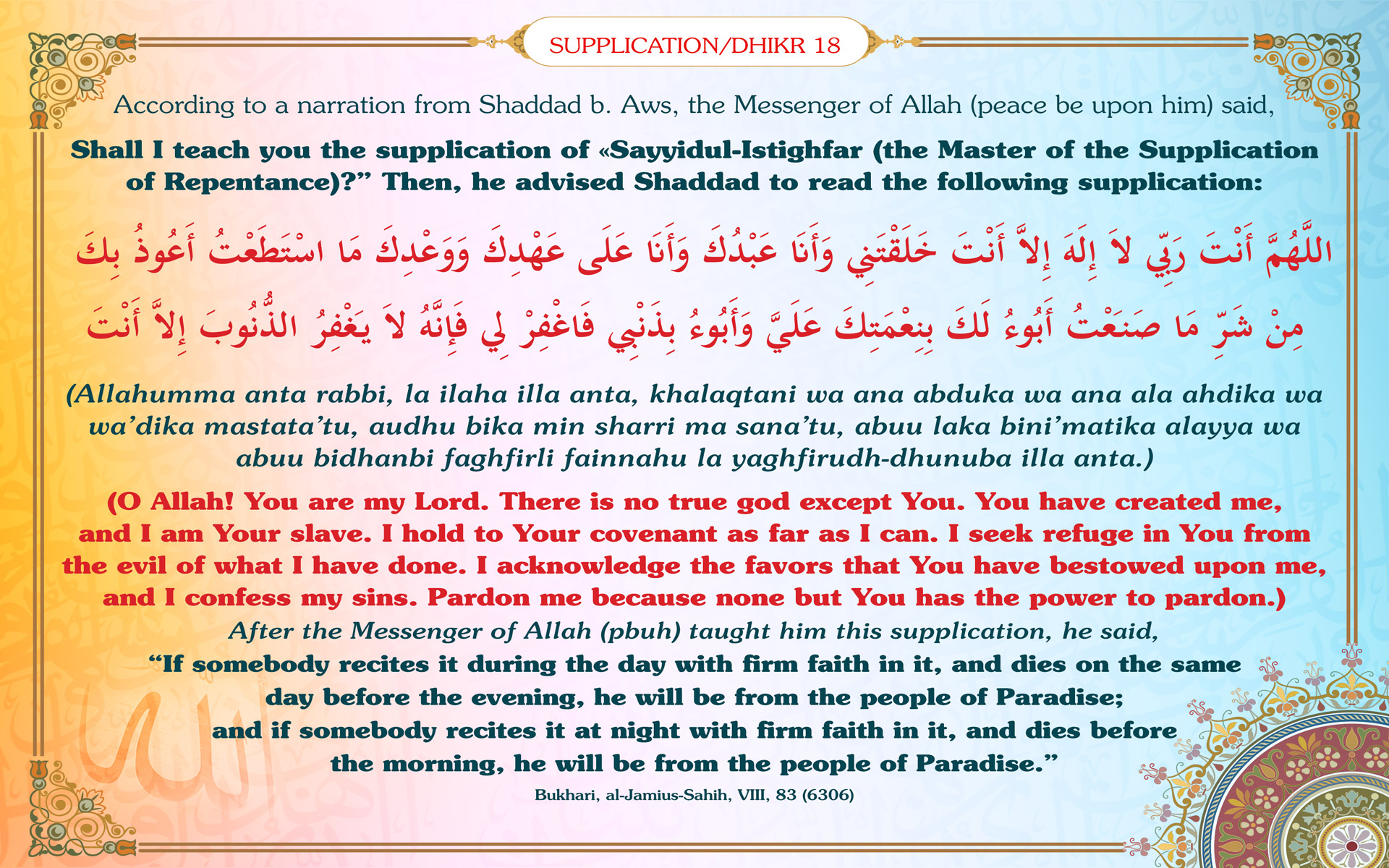
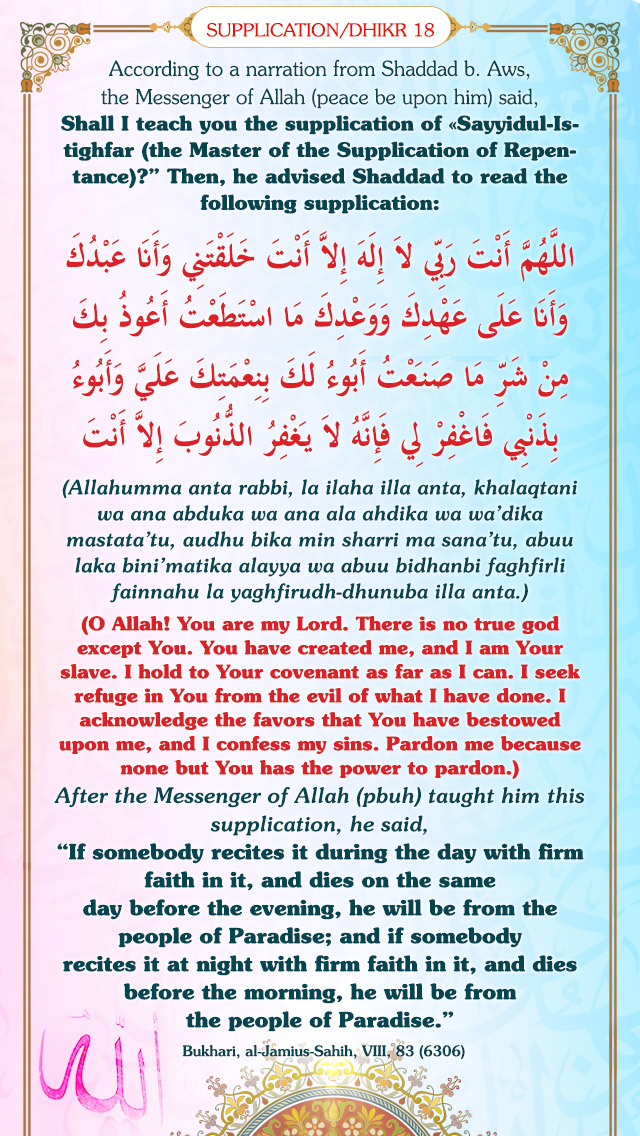
According to a narration from Shaddad b. Aws, the Messenger of Allah (peace be upon him) said,
Shall I teach you the supplication of «Sayyidul-Istighfar (the Master of the Supplication of Repentance)?” Then, he advised Shaddad to read the following supplication:
اللَّهُمَّ أَنْتَ رَبِّي لاَ إِلَهَ إِلاَّ أَنْتَ خَلَقْتَنِي وَأَنَا عَبْدُكَ وَأَنَا عَلَى عَهْدِكَ وَوَعْدِكَ مَا اسْتَطَعْتُ أَعُوذُ بِكَ مِنْ شَرِّ مَا صَنَعْتُ أَبُوءُ لَكَ بِنِعْمَتِكَ عَلَيَّ وَأَبُوءُ بِذَنْبِي فَاغْفِرْ لِي فَإِنَّهُ لاَ يَغْفِرُ الذُّنُوبَ إِلاَّ أَنْتَ
(Allahumma anta rabbi, la ilaha illa anta, khalaqtani wa ana abduka wa ana ala ahdika wa wa’dika mastata’tu, audhu bika min sharri ma sana’tu, abuu laka bini’matika alayya wa abuu bidhanbi faghfirli fainnahu la yaghfirudh-dhunuba illa anta.)
(O Allah! You are my Lord. There is no true god except You. You have created me, and I am Your slave. I hold to Your covenant as far as I can. I seek refuge in You from the evil of what I have done. I acknowledge the favors that You have bestowed upon me, and I confess my sins. Pardon me because none but You has the power to pardon.)
After the Messenger of Allah (pbuh) taught him this supplication, he said,
“If somebody recites it during the day with firm faith in it, and dies on the same day before the evening, he will be from the people of Paradise; and if somebody recites it at night with firm faith in it, and dies before the morning, he will be from the people of Paradise.”
Bukhari, al-Jamius-Sahih, VIII, 83 (6306)
Download (769.46 KB)

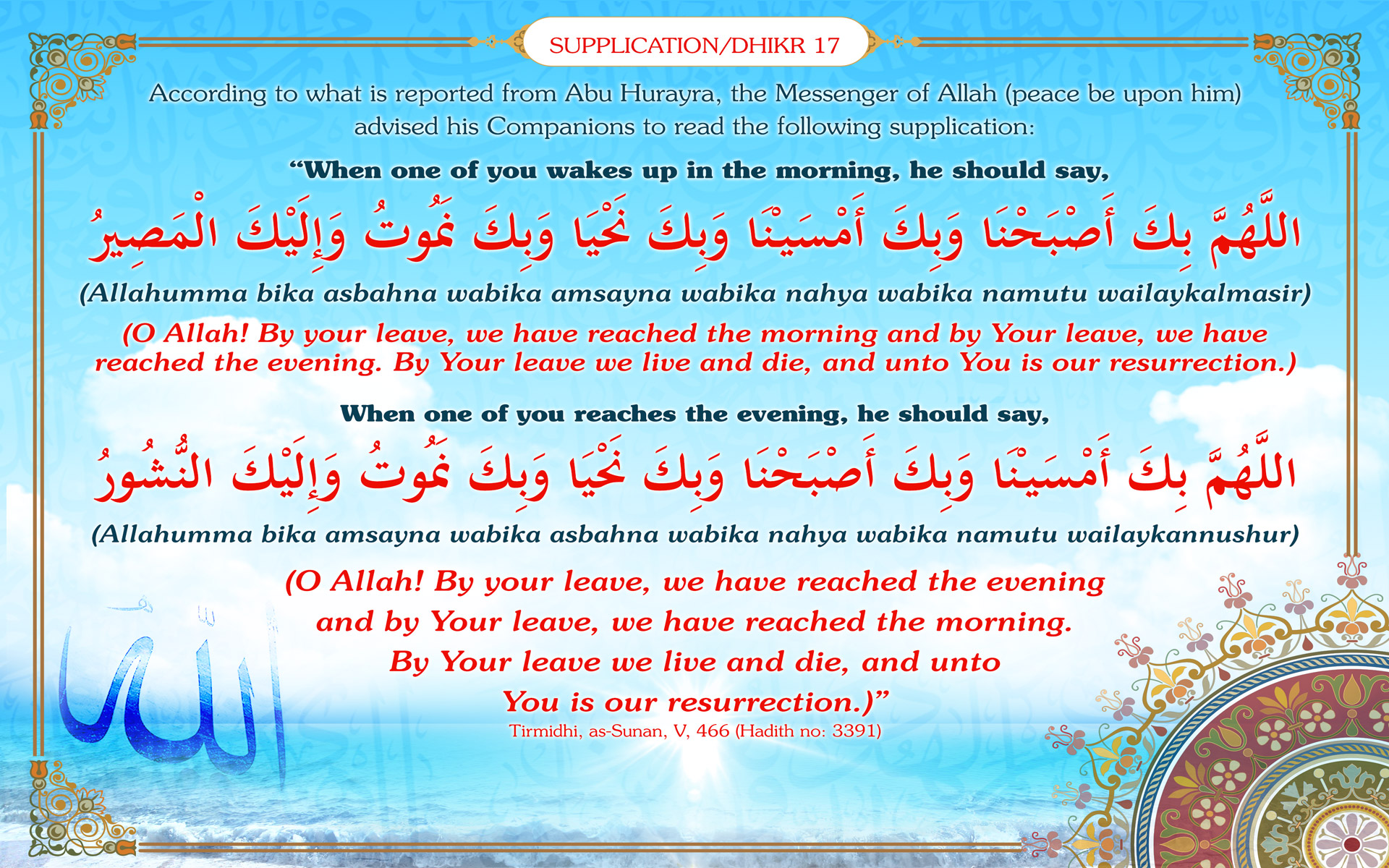
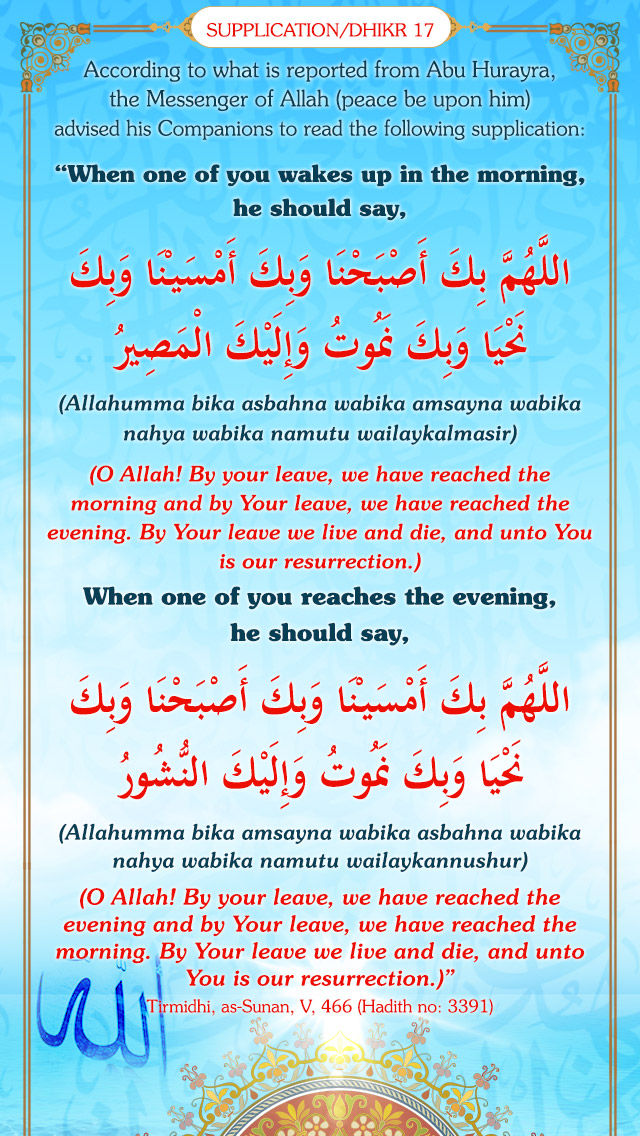
According to what is reported from Abu Hurayra, the Messenger of Allah (peace be upon him)
advised his Companions to read the following supplication:
“When one of you wakes up in the morning, he should say,
اللَّهُمَّ بِكَ أَصْبَحْنَا وَبِكَ أَمْسَيْنَا وَبِكَ نَحْيَا وَبِكَ نَمُوتُ وَإِلَيْكَ الْمَصِيرُ
(Allahumma bika asbahna wabika amsayna wabika nahya wabika namutu wailaykalmasir)
(O Allah! By your leave, we have reached the morning and by Your leave, we have reached the evening. By Your leave we live and die, and unto You is our resurrection.)
When one of you reaches the evening, he should say,
اللَّهُمَّ بِكَ أَمْسَيْنَا وَبِكَ أَصْبَحْنَا وَبِكَ نَحْيَا وَبِكَ نَمُوتُ وَإِلَيْكَ النُّشُورُ
(Allahumma bika amsayna wabika asbahna wabika nahya wabika namutu wailaykannushur)
(O Allah! By your leave, we have reached the evening and by Your leave, we have reached the morning. By Your leave we live and die, and unto You is our resurrection.)”
Tirmidhi, as-Sunan, V, 466 (Hadith no: 3391)
Download (824.66 KB)

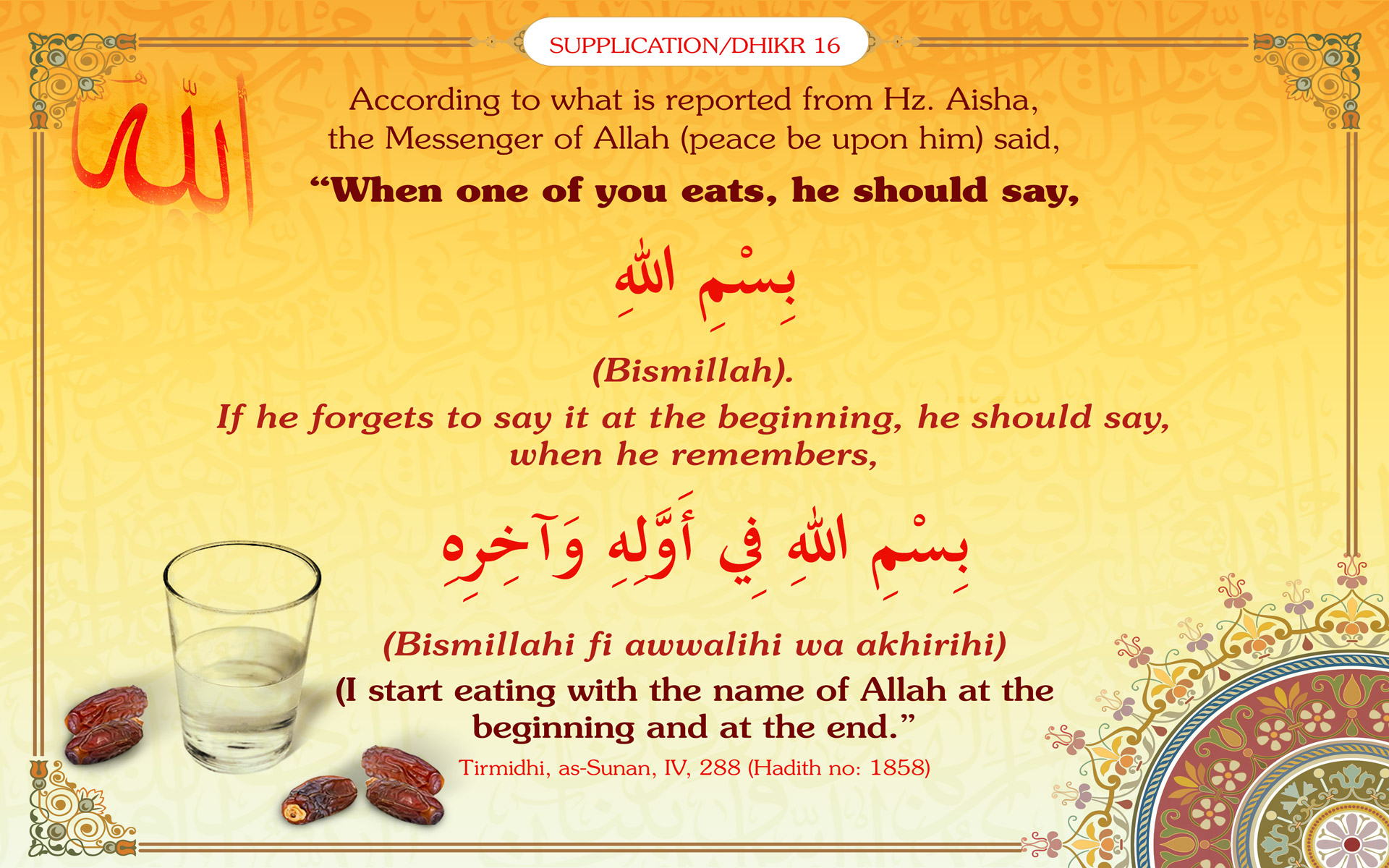
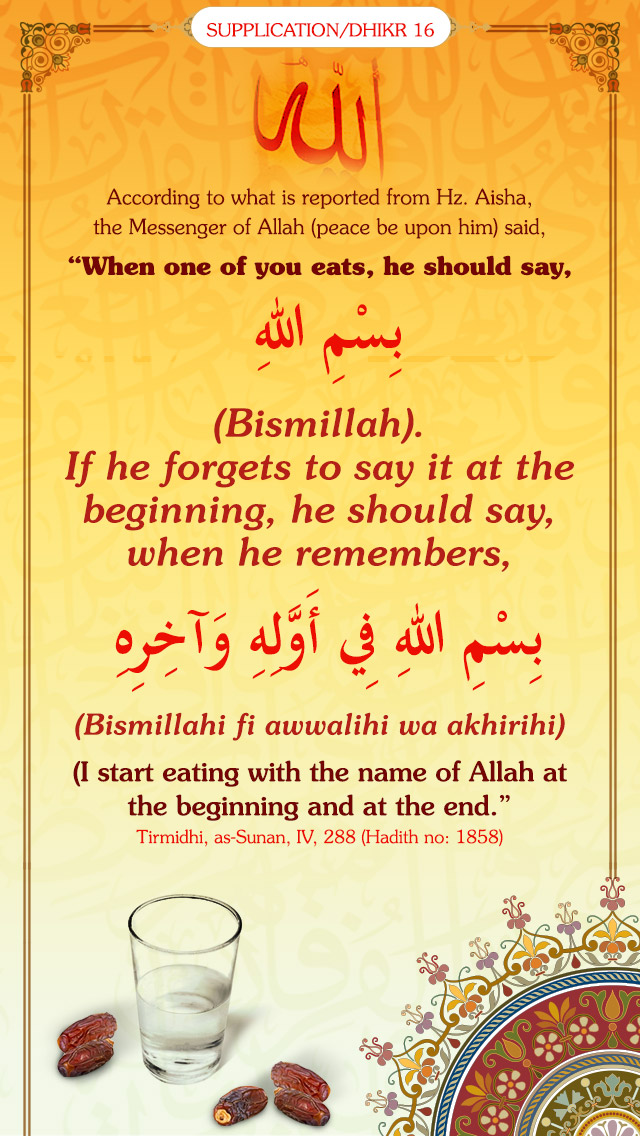
According to what is reported from Hz. Aisha,
the Messenger of Allah (peace be upon him) said,
“When one of you eats, he should say,
بِسْمِ اللهِ
(Bismillah).
If he forgets to say it at the beginning, he should say, when he remembers,
بِسْمِ اللهِ فِي أَوَّلِهِ وَآخِرِهِ
(Bismillahi fi awwalihi wa akhirihi)
(I start eating with the name of Allah at the beginning and at the end.”
Tirmidhi, as-Sunan, IV, 288 (Hadith no: 1858)
Download (558.41 KB)

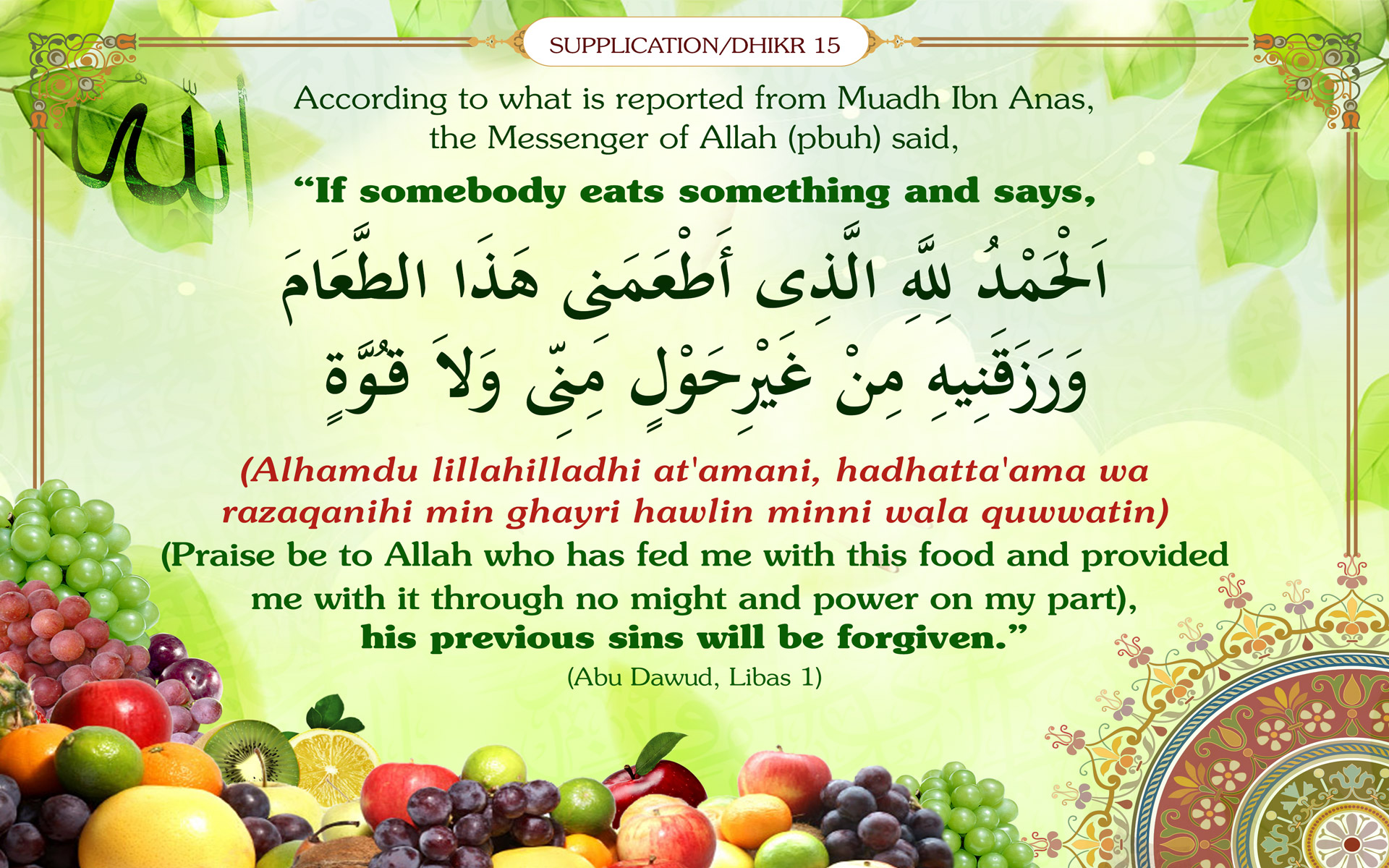
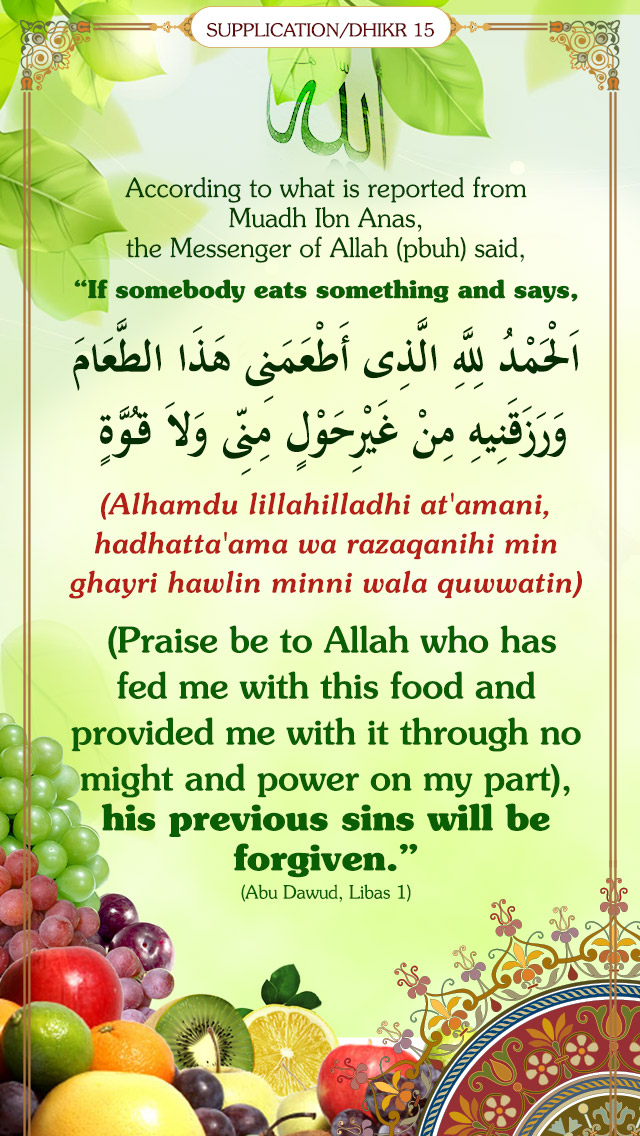
According to what is reported from Muadh Ibn Anas,
the Messenger of Allah (pbuh) said,
“If somebody eats something and says,
اَلْحَمْدُ لِلَّهِ الَّذِى أَطْعَمَنِى هَذَا الطَّعَامَ
وَرَزَقَنِيهِ مِنْ غَيْرِحَوْلٍ مِنِّى وَلاَ قُوَّةٍ
(Alhamdu lillahilladhi at'amani, hadhatta'ama wa razaqanihi min ghayri hawlin minni wala quwwatin)
(Praise be to Allah who has fed me with this food and provided me with it through no might and power on my part),
his previous sins will be forgiven.”
(Abu Dawud, Libas 1)
Download (624.18 KB)

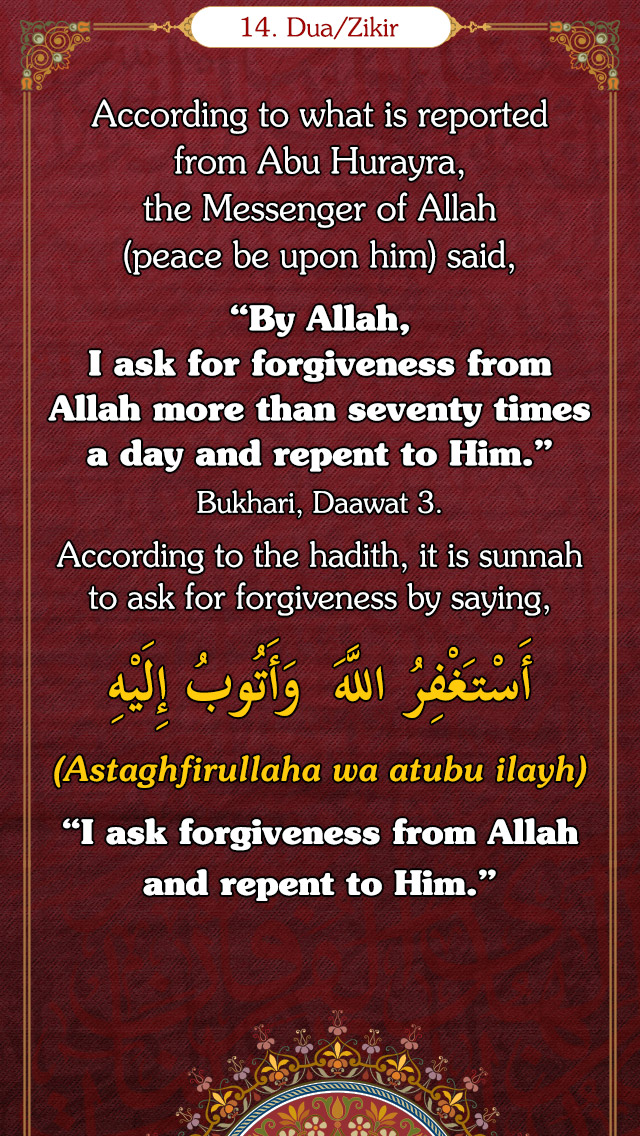
According to what is reported from Abu Hurayra,
the Messenger of Allah (peace be upon him) said,
“By Allah, I ask for forgiveness from Allah more than seventy times a day and repent to Him.”
Bukhari, Daawat 3.
According to the hadith, it is sunnah to ask for forgiveness by saying,
أَسْتَغْفِرُ اللَّهَ وَأَتُوبُ إِلَيْهِ
(Astaghfirullaha wa atubu ilayh)
“I ask forgiveness from Allah and repent to Him.”
Download (979.4 KB)

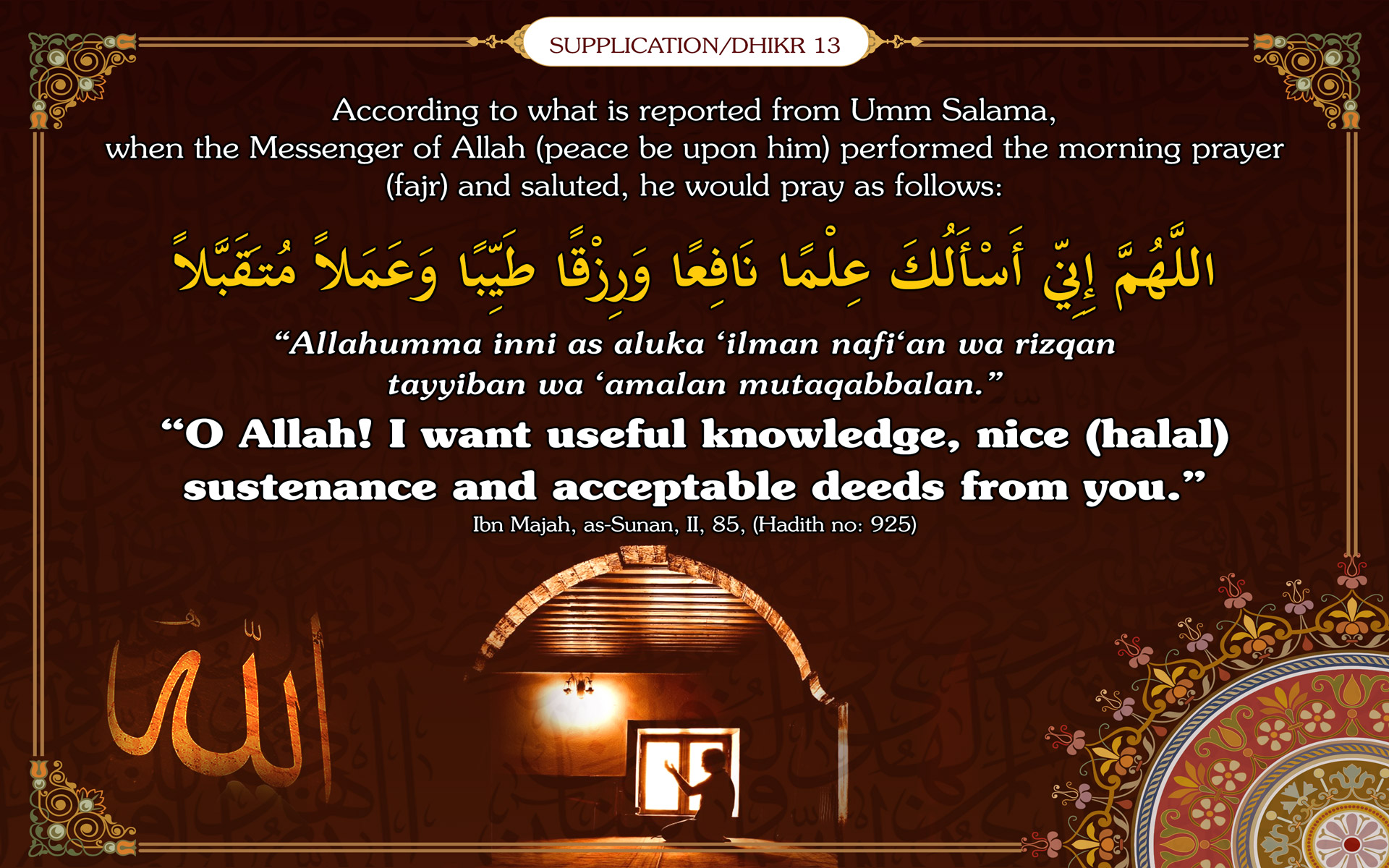
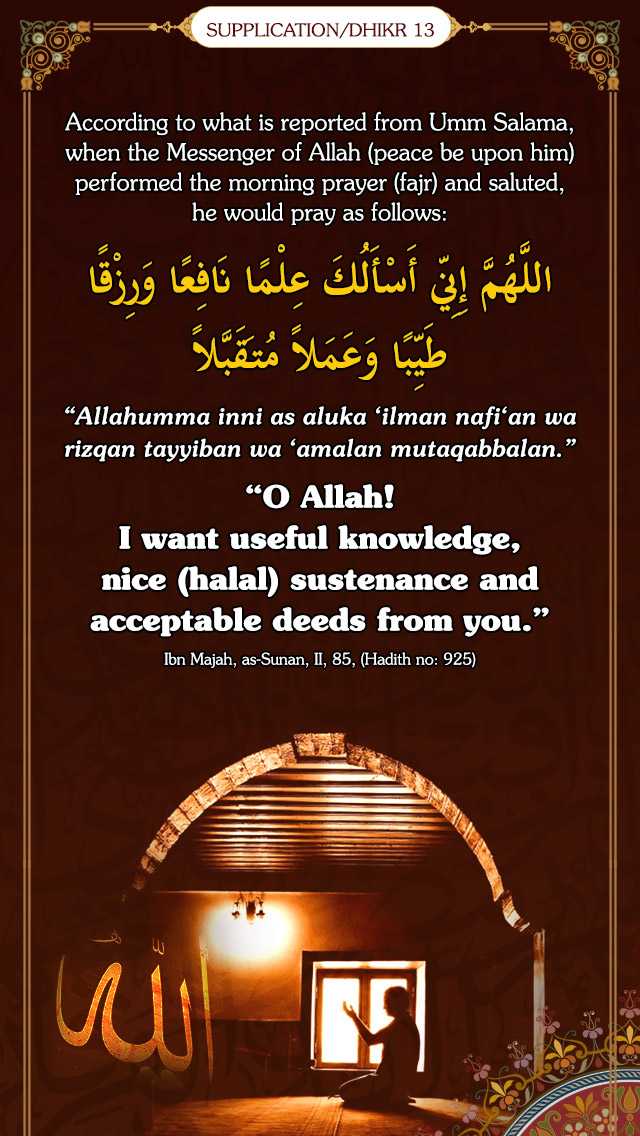
According to what is reported from Umm Salama,
when the Messenger of Allah (peace be upon him) performed the morning prayer (fajr) and saluted, he would pray as follows:
اللَّهُمَّ إِنِّي أَسْأَلُكَ عِلْمًا نَافِعًا وَرِزْقًا طَيِّبًا وَعَمَلاً مُتَقَبَّلاً
“Allahumma inni as aluka ‘ilman nafi‘an wa rizqan tayyiban wa ‘amalan mutaqabbalan.”
“O Allah! I want useful knowledge, nice (halal) sustenance and acceptable deeds from you.”
Ibn Majah, as-Sunan, II, 85, (Hadith no: 925)
Download (576.17 KB)

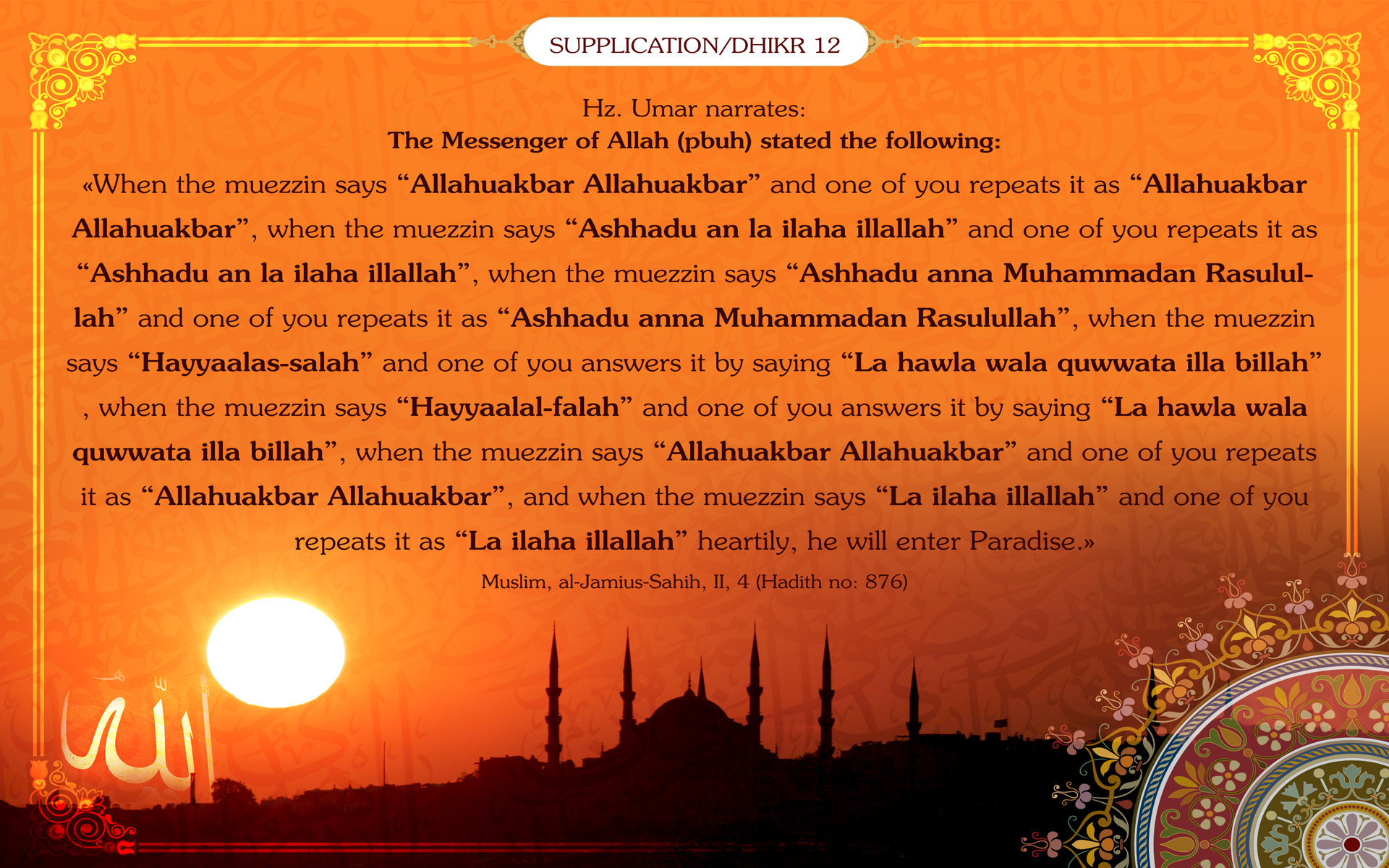
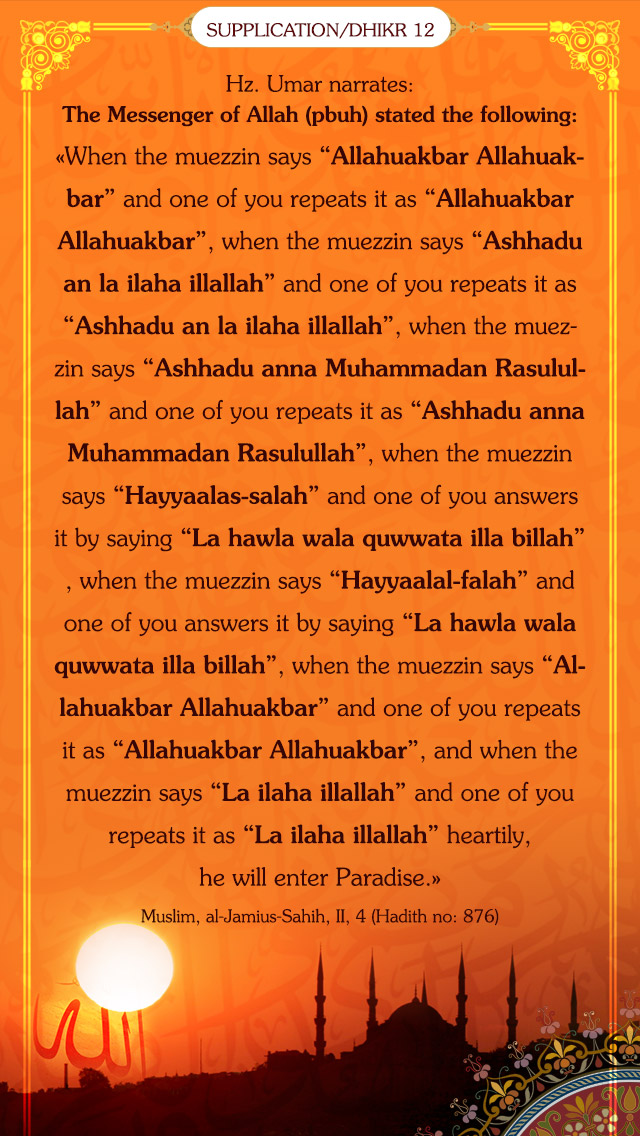
Hz. Umar narrates:
The Messenger of Allah (pbuh) stated the following:
«When the muezzin says “Allahuakbar Allahuakbar” and one of you repeats it as “Allahuakbar Allahuakbar”, when the muezzin says “Ashhadu an la ilaha illallah” and one of you repeats it as “Ashhadu an la ilaha illallah”, when the muezzin says “Ashhadu anna Muhammadan Rasulullah” and one of you repeats it as “Ashhadu anna Muhammadan Rasulullah”, when the muezzin says “Hayyaalas-salah” and one of you answers it by saying “La hawla wala quwwata illa billah” , when the muezzin says “Hayyaalal-falah” and one of you answers it by saying “La hawla wala quwwata illa billah”, when the muezzin says “Allahuakbar Allahuakbar” and one of you repeats it as “Allahuakbar Allahuakbar”, and when the muezzin says “La ilaha illallah” and one of you repeats it as “La ilaha illallah” heartily, he will enter Paradise.»
Muslim, al-Jamius-Sahih, II, 4 (Hadith no: 876)
Download (644.9 KB)

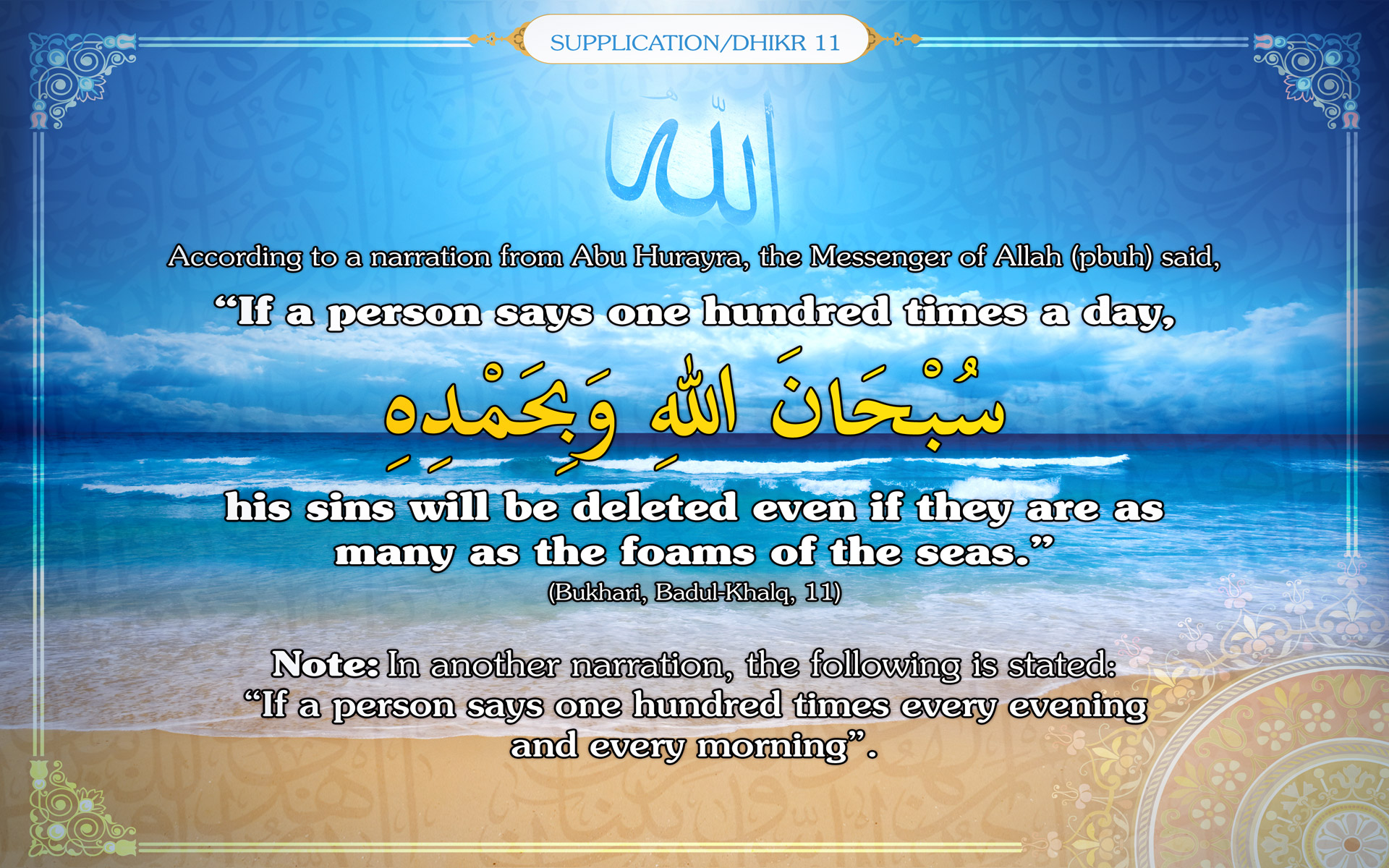
According to a narration from Abu Hurayra, the Messenger of Allah (pbuh) said,
“If a person says one hundred times a day,
سُبْحَانَ اللهِ وَبِحَمْدِهِ
his sins will be deleted even if they are as many as the foams of the seas.”
(Bukhari, Badul-Khalq, 11)
Note: In another narration, the following is stated: “If a person says one hundred times every evening and every morning”.
Download (666.95 KB)

According to what Aban b. Uthman reports, Hz. Uthman said,
The Messenger of Allah (pbuh) stated the following:
“If a person says three times in the evening,
بِسْمِ اللَّهِ الَّذِى لاَ يَضُرُّ مَعَ اسْمِهِ شَىْءٌ فِى الْأَرْضِ
وَلاَ فِى السَّمَاءِ وَهُوَ السَّمِيعُ الْعَلِيمُ
a misfortune will not hit him suddenly until the morning. If he utters the same supplication three times in the morning, he will not encounter a misfortune suddenly until the evening.”
Muslim, Dhikr, 37 (2698)
Note: Aban b. Uthman, who reported that hadith, became paralyzed. Somebody who heard that hadith from him stared at him. Thereupon, Aban said to him, ‘Why are you staring at me? The hadith is as I have told you. I have not told you a lie about Hz. Uthman. Hz. Uthman did not lie about the Messenger of Allah (pbuh) either. However, I could not report that hadith on that day so that Allah’s predestination would occur.’ (Abu Dawud, Adab, 101)
Download (681.81 KB)

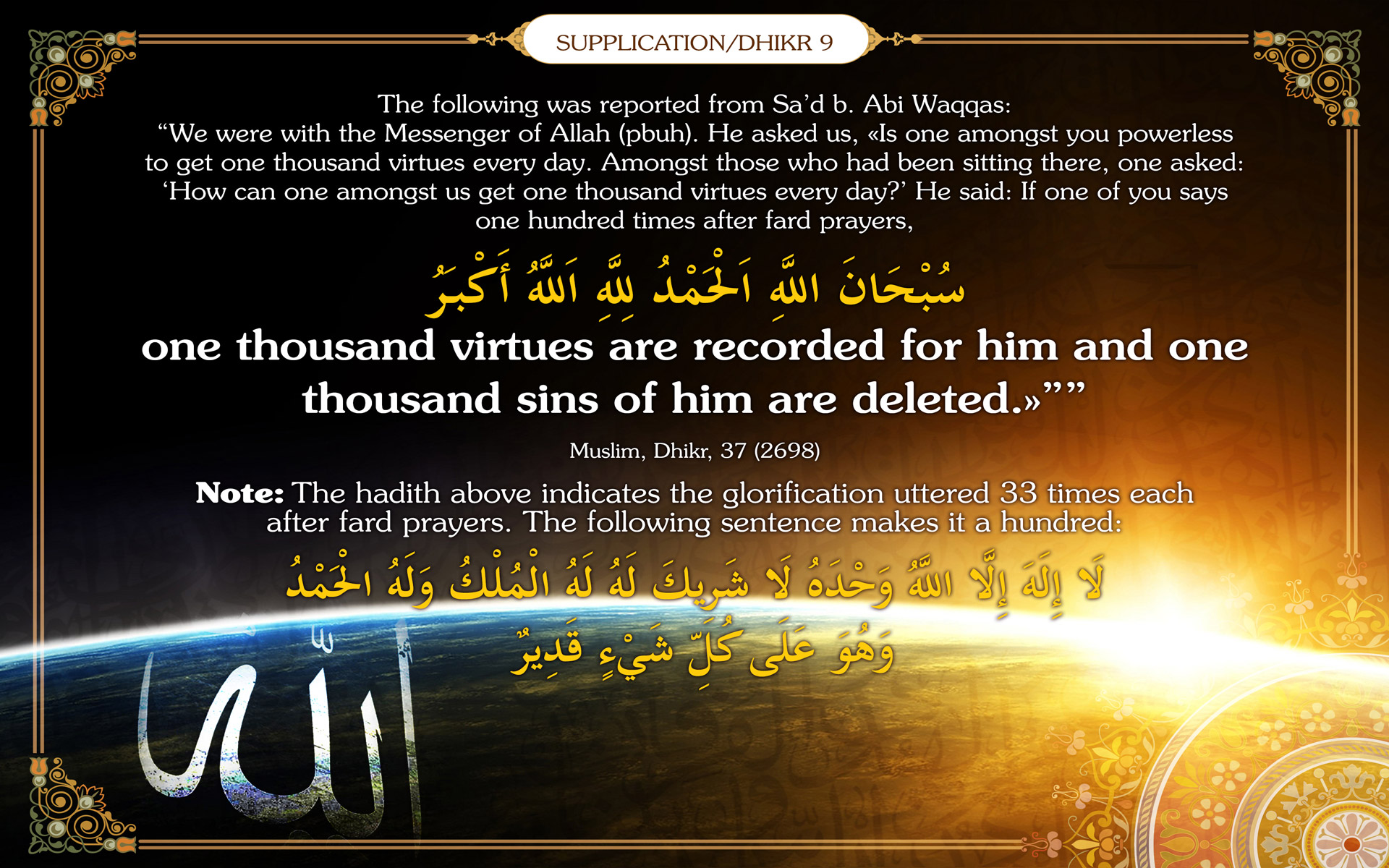
The following was reported from Sa’d b. Abi Waqqas:
“We were with the Messenger of Allah (pbuh). He asked us, «Is one amongst you powerless to get one thousand virtues every day. Amongst those who had been sitting there, one asked: ‘How can one amongst us get one thousand virtues every day?’ He said: If one of you says one hundred times after fard prayers,
سُبْحَانَ اللَّهِ اَلْحَمْدُ لِلَّهِ اَللَّهُ أَكْبَرُ
one thousand virtues are recorded for him and one thousand sins of him are deleted.»”
Muslim, Dhikr, 37 (2698)
Note: The hadith above indicates the glorification uttered 33 times each after fard prayers. The following sentence makes it a hundred:
لَا إِلَهَ إِلَّا اللَّهُ وَحْدَهُ لَا شَرِيكَ لَهُ لَهُ الْمُلْكُ وَلَهُ الْحَمْدُ
وَهُوَ عَلَى كُلِّ شَيْءٍ قَدِيرٌ
Download (578.35 KB)

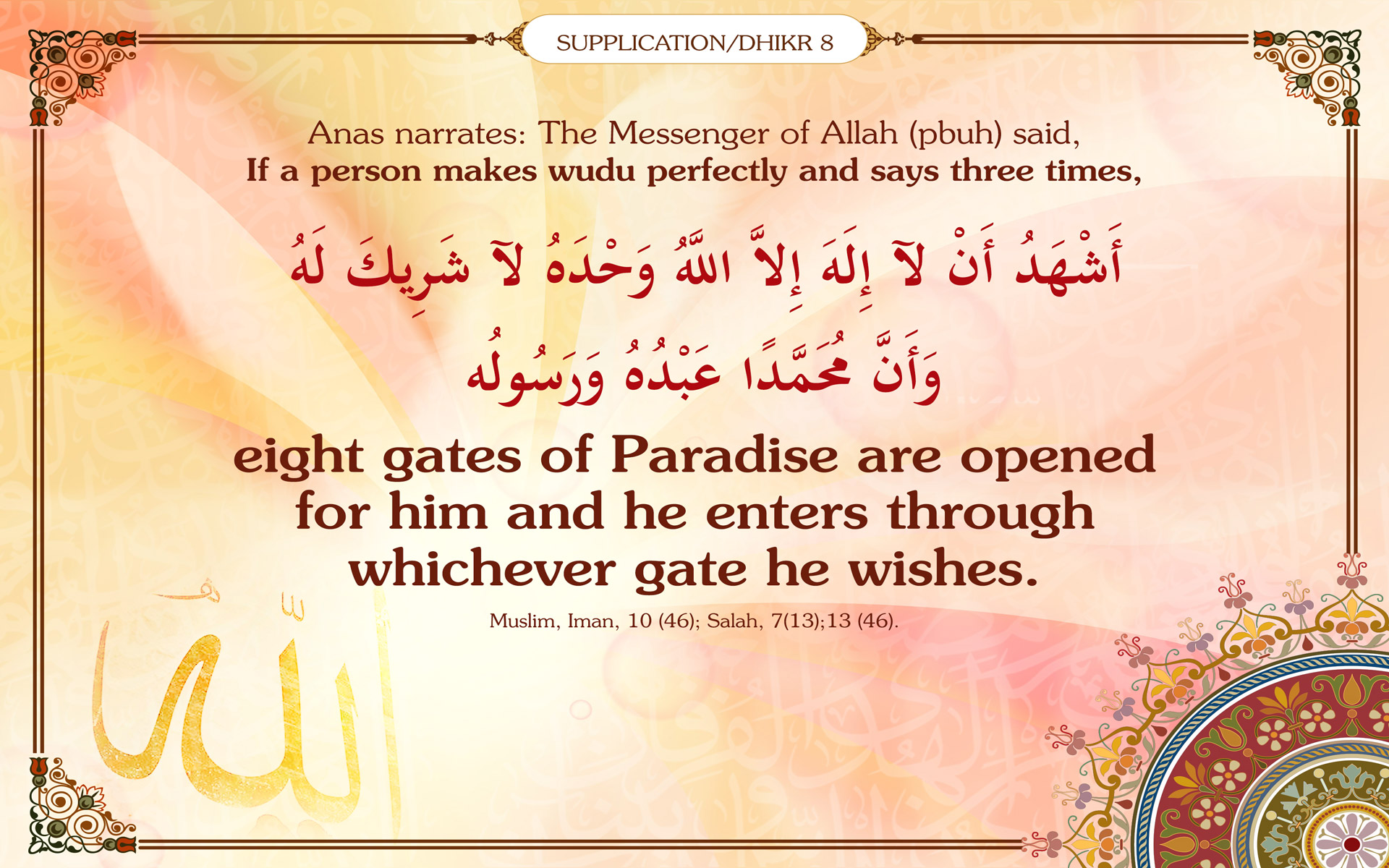
Anas narrates: The Messenger of Allah (pbuh) said,
If a person makes wudu perfectly and says three times,
أَشْهَدُ أَنْ ﻵ إِلَهَ إِلاَّ اللَّهُ وَحْدَهُ ﻵ شَرِيكَ لَهُ
وَأَنَّ مُحَمَّدًا عَبْدُهُ وَرَسُولُه
eight gates of Paradise are opened for him and he enters through whichever gate he wishes.
Muslim, Iman, 10 (46); Salah, 7(13);13 (46).
Download (516.26 KB)

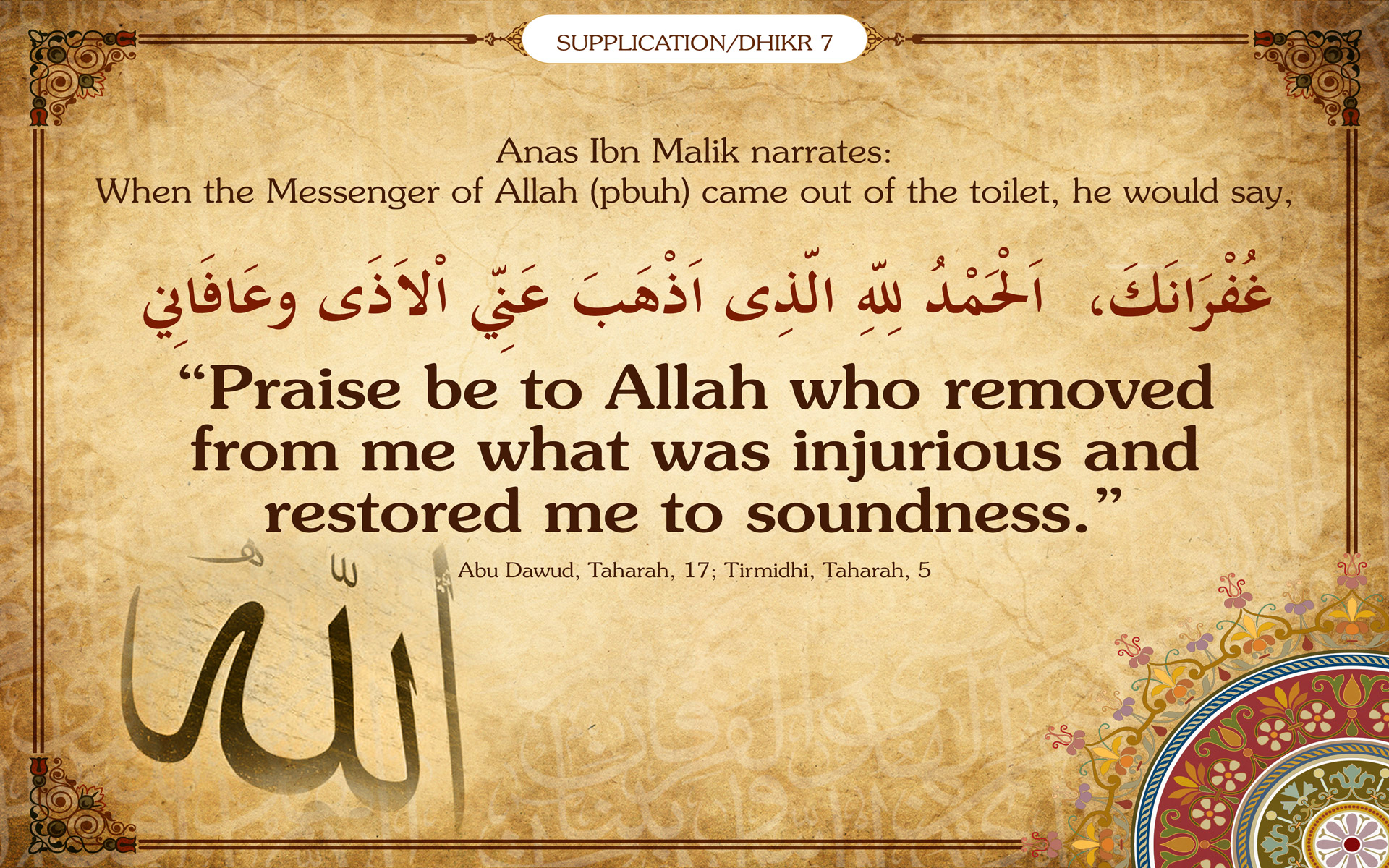
Anas Ibn Malik narrates: When the Messenger of Allah (pbuh) came out of the toilet, he would say,
غُفْرَانَكَ، اَلْحَمْدُ لِلّهِ الّذِى اَذْهَبَ عَنِّي اْلاَذَى وعَافَانِي
“Praise be to Allah who removed from me what was injurious and restored me to soundness.”
Abu Dawud, Taharah, 17; Tirmidhi, Taharah, 5.
Download (833.87 KB)

Abu Umama (r.a.) narrates: The Messenger of Allah (peace be upon him) said,
When one of you enters the toilet, he should read the following supplication:
اللَّهُمَّ إنِّي أعُوذُ بِكَ مِنَ الرِّجْسِ النَّجَسِ الْخَبِيثِ الْمُخْبِثِ الشَّيْطَانِ الرَّجِيمِ
“O Allah! I take refuge in You from the accursed Satan, who is dirty, impure, stinking and noxious.”
Bukhari, Daawat 7, 15, Tawhid 13; Muslim, Dhikr, 59.
Download (533.84 KB)

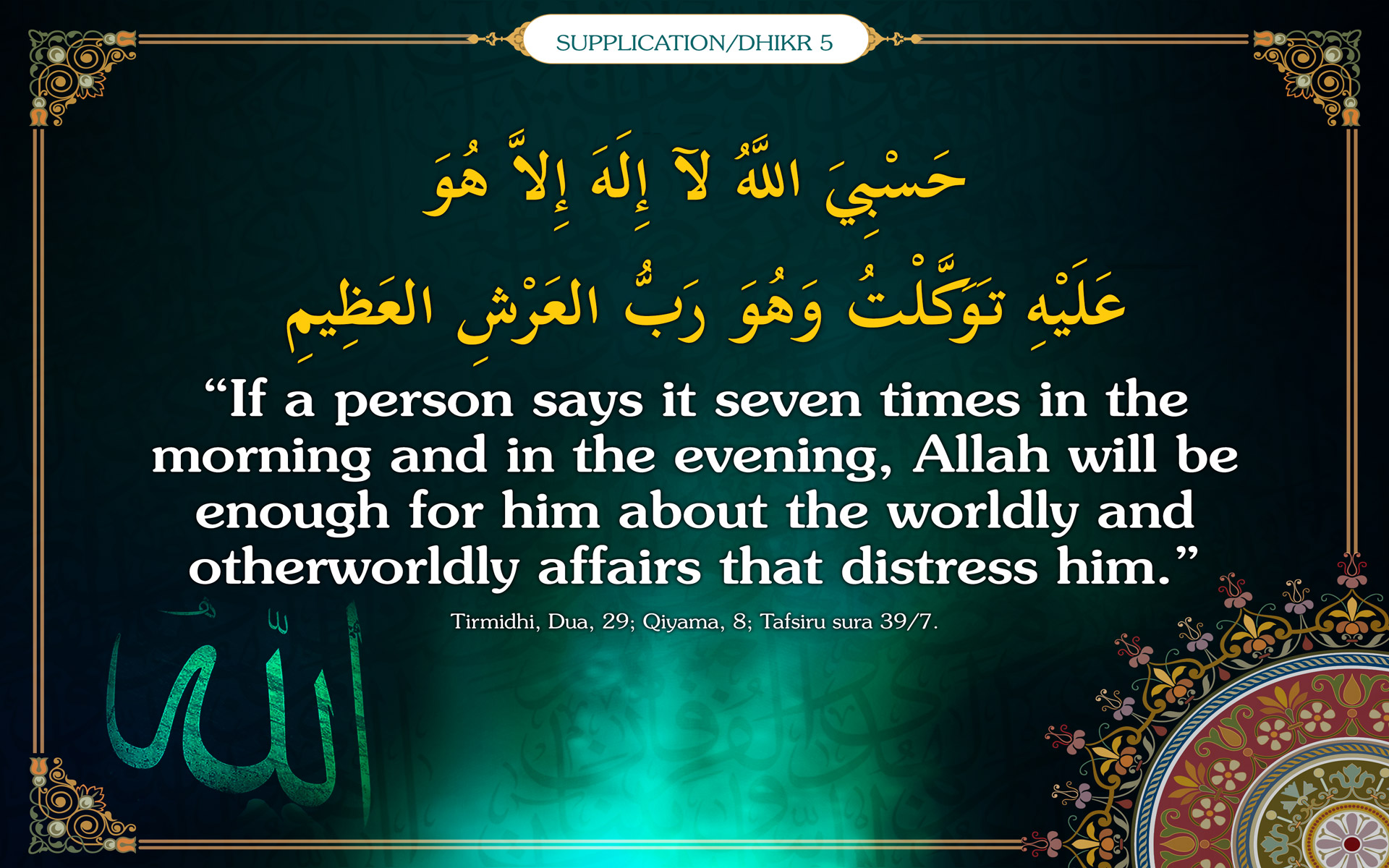
حَسْبِيَ اللَّهُ ﻵ إِلَهَ إِلاَّ هُوَ
عَلَيْهِ تَوَكَّلْتُ وَهُوَ رَبُّ العَرْشِ العَظِيمِ
“If a person says it seven times in the morning and in the evening, Allah will be enough for him about the worldly and otherworldly affairs that distress him.”
Tirmidhi, Dua, 29; Qiyama, 8; Tafsiru sura 39/7.
Download (511.15 KB)

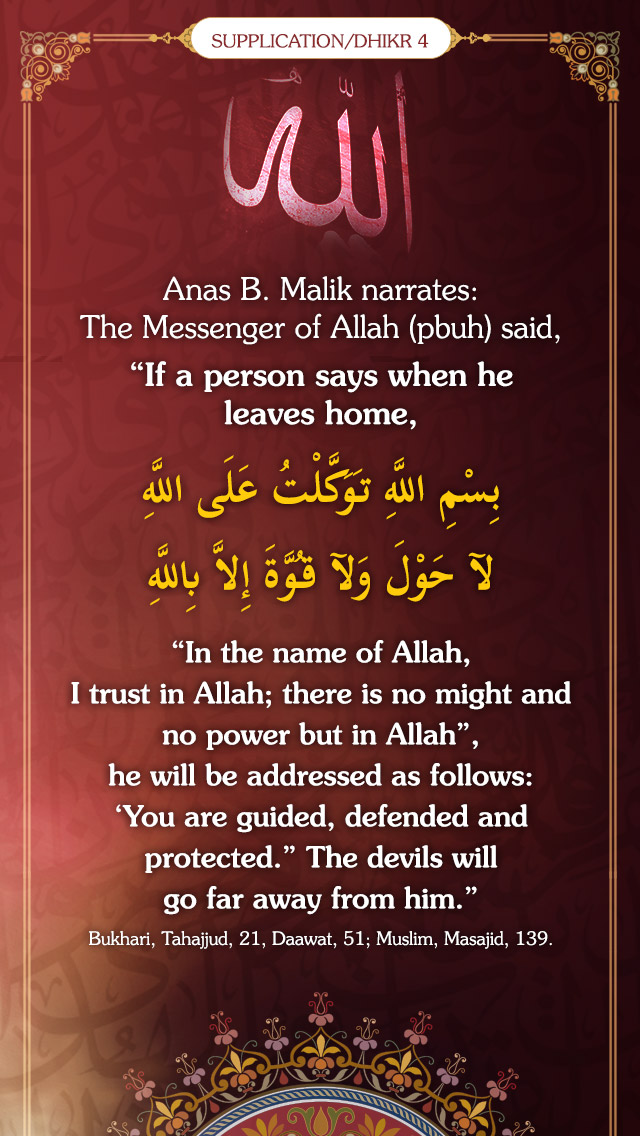
Anas B. Malik narrates: The Messenger of Allah (pbuh) said,
“If a person says when he leaves home,
بِسْمِ اللَّهِ تَوَكَّلْتُ عَلَى اللَّهِ، ﻵ حَوْلَ وَﻵ قُوَّةَ إِلاَّ بِاللَّهِ
“In the name of Allah, I trust in Allah; there is no might and no power but in Allah”, he will be addressed as follows: ‘You are guided, defended and protected.” The devils will go far away from him.”
Bukhari, Tahajjud, 21, Daawat, 51; Muslim, Masajid, 139.
Download (554.77 KB)

Juwayriya narrates: One morning, the Prophet (pbuh) left my room early to perform the morning prayer (fajr). He returned later that morning. Juwayriya was still sitting. The Messenger of Allah (pbuh) asked, "Have you been sitting in the same place since I left you?" She replied, "Yes, I have." Thereupon, the Prophet said,
"I recited four phrases three times after I left you. If they were to be weighed against what you had been reciting since dawn, they would still outweigh them. They are as follows:
سُبْحَانَ اللَّهِ وَبِحَمْدِهِ عَدَدَ خَلْقِهِ ورِضَا نَفْسِهِ
وَزِنَةَ عَرْشِهِ وَمِدَادَ كَلِمَاتِهِ
“Glory be to Allah and Praise be to Him as much as the number of His creations, and His pleasure, and the weight of His Throne, and the ink of His words.”
Bukhari, Daawat 7, 15, Tawhid 13; Muslim, Dhikr, 59.
Download (654.26 KB)

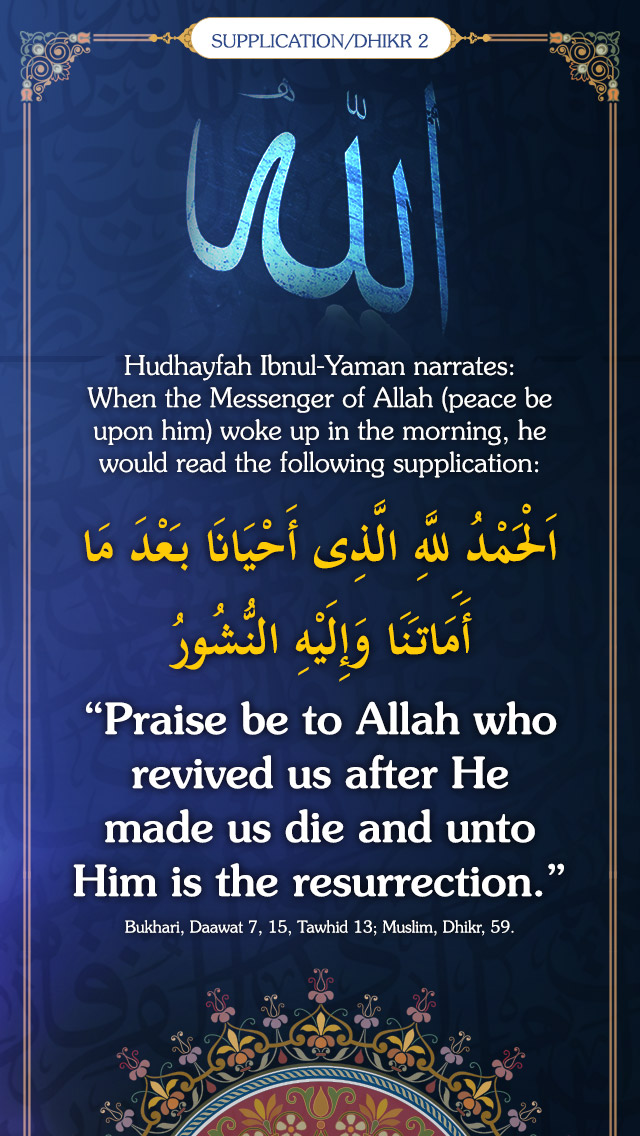
Hudhayfah Ibnul-Yaman narrates:
When the Messenger of Allah (peace be upon him) woke up in the morning, he would read the following supplication:
اَلْحَمْدُ ِللَّهِ الَّذِى أَحْيَانَا بَعْدَ مَا أَمَاتَنَا وَإِلَيْهِ النُّشُورُ
“Praise be to Allah who revived us after He made us die and unto Him is the resurrection.”
Bukhari, Daawat 7, 15, Tawhid 13; Muslim, Dhikr, 59.
Download (565.48 KB)

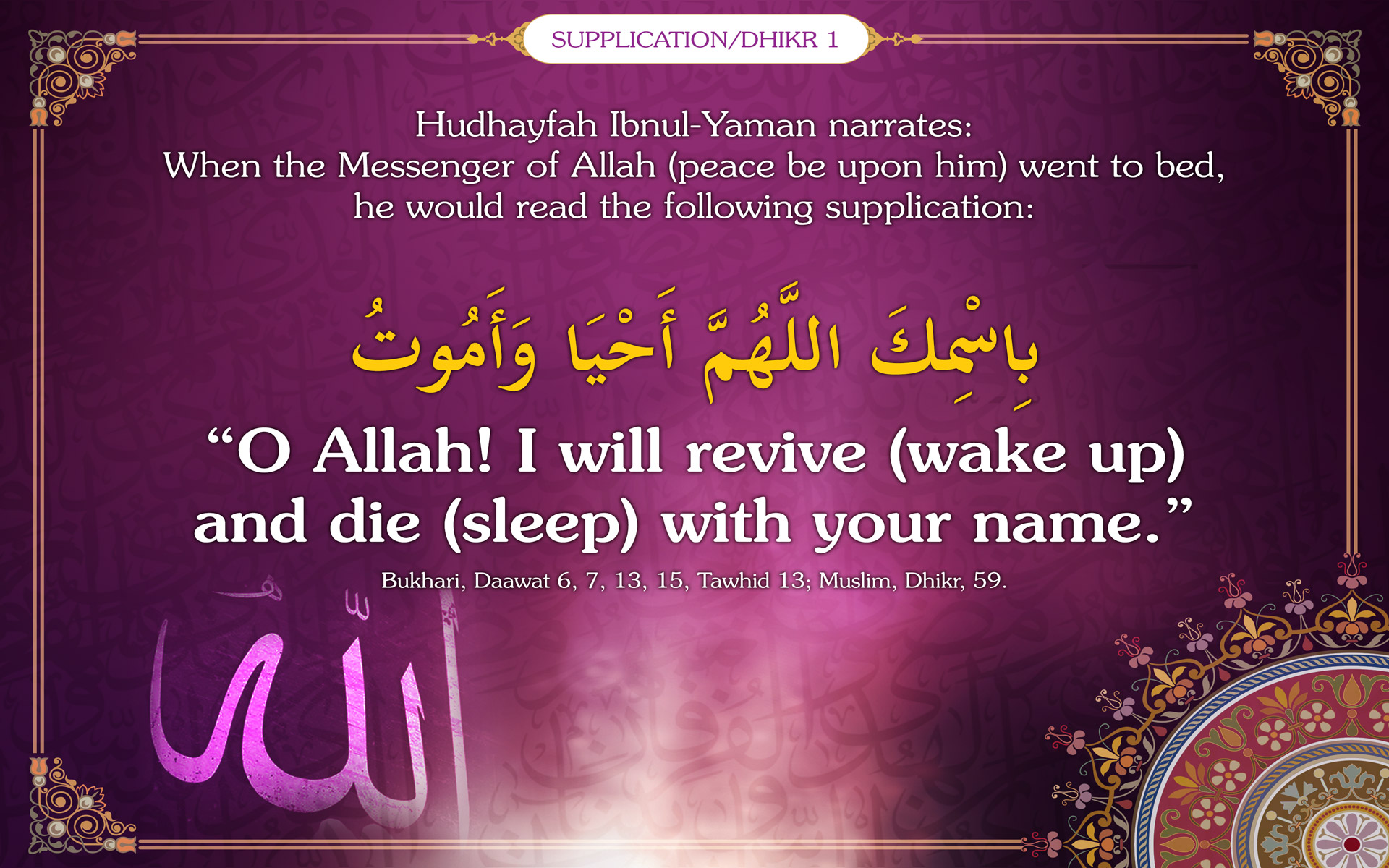
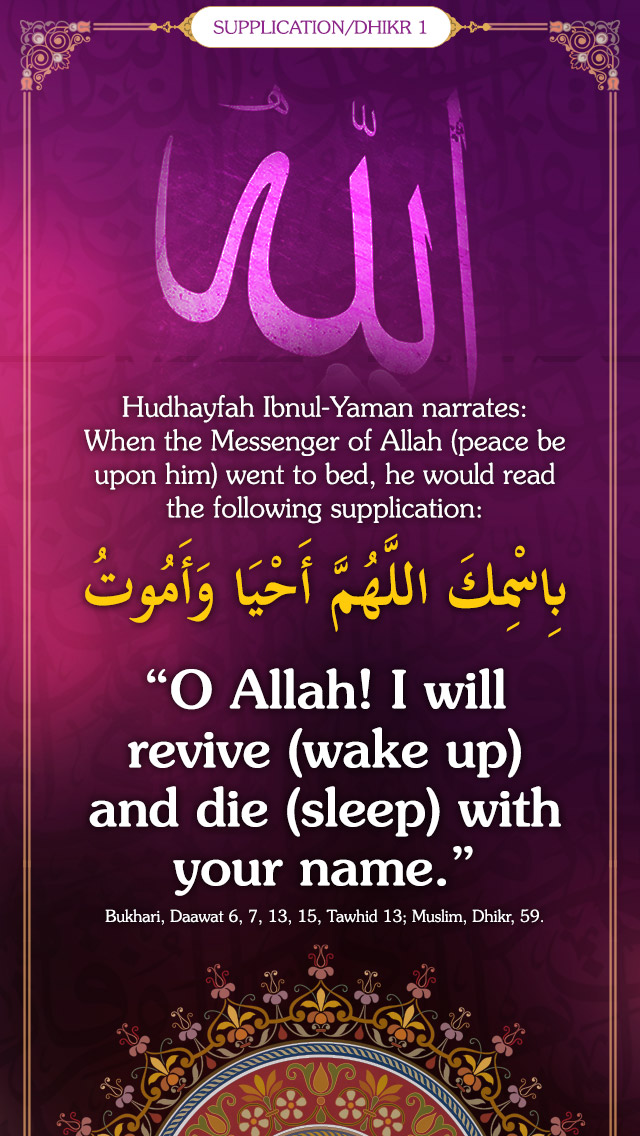
Hudhayfah Ibnul-Yaman narrates:
When the Messenger of Allah (peace be upon him) went to bed, he would read the following supplication:
بِاسْمِكَ اللَّهُمَّ أَحْيَا وَأَمُوتُ
“O Allah! I will revive (wake up) and die (sleep) with your name.”
Bukhari, Daawat 6, 7, 13, 15, Tawhid 13; Muslim, Dhikr, 59.
Download (514.1 KB)
 Download (1.08 MB)
 Download (2.76 MB)
 Download (679.27 KB)
 Download (1.84 MB)
 Download (1.07 MB)