
If you feel that you believe in Islam and would like to become a Muslim you need to pronounce the shahada (the confession of faith) with a voice that you can hear and with conviction and understanding its meaning:
I testify "La ilah illa Allah, Muhammad rasoolu Allah."
These Arabic words (called Shahada or the testimony) mean "There is no true god (deity) but God (Allah), and Muhammad is the Messenger (Prophet) of God."
The first part, "There is no true god but God," means that none has the right to be worshipped but God alone, and that God has neither partner nor son. The second part means that
Muhammad is a true Prophet sent by God to humankind.
To be a Muslim, one should also:
- Believe that the Holy Quran is the literal word of God, revealed by Him.
- Believe that the Judgment Day (Resurrection Day) is true and will come, as God promised in the Quran.
- Accept Islam as his or her religion.
- Not worship anything or anyone, except God.
It is that easy. You can do it now without the need to be in front of a Muslim, even though it is better so he/she may correct your pronunciation.
Once you pronounce the testimony with conviction, then you have become a Muslim. It is between you and God.
Most Read in the Category of Islam - Muslim
Man is a being that can commit sins. There is nobody who can say, “It is impossible for me to commit sins.” Everybody approaches the pit of sins somehow and sometimes falls into it.
We continue our lives in a balance of the mind and heart. However, since man does not consist of the mind and heart only, sometimes we cannot control our will and commit sins by being aware or unaware of it under the influence of dominant feelings, primarily the soul, disobedient feelings, unbridled desires and irresistible illusions.
Actually, Allah created various means to make us approach Him, need Him and attract us to Him. For instance, He gave us the feeling of hunger to make us need sustenance and show that He was ar-Razzaq (the Sustainer) and made us stick to Him. As slaves, we asked from Him all of our needs; we recognized Him as the Sustainer, the real provider of sustenance. That is the name ar-Razzaq makes it necessary for us to feel hungry.
Similarly, we are sinners. Allah is the Forgiver. We make mistakes; Allah forgives us. We disobey Him; Allah pardons us. We repent; Allah accepts our repentance. Allah is al- Ghafur (the Pardoner), al-Afuww (the Pardoner), al-Ghaffar (the Forgiving), at-Tawwab (the Acceptor to Repentance). The sins that we commit take us to those names of Allah and lead us toward Him. Thus, we know Allah by His names, al-Ghafur and al-Ghaffar. As Badiuzzaman says, “the name al-Ghaffar necessitates the existence of sins, and the name as-Sattar (the Veiler) necessitates the existence of mistakes.’ To put it more clearly, sins need to be committed so that the name of Allah, al-Ghaffar, will be manifest. Mistakes need to be made so that Allah will show that He does not display His servants’ mistakes and show that he is as-Sattar.
Our beloved Prophet expresses that nice reality beautifully as follows in a hadith:
By Him in Whose Hand is my life, if you were not to commit sin, Allah would sweep you out of existence and He would replace you by those people who would commit sin and seek forgiveness from Allah, and He would have pardoned them.”1
There should be as much repentance as the amount of sins
Man is deceived by his soul and devil; he cannot control his sins and his will, and then commits a sin; then he regrets doing it and repents time and time again. According to what we learn from hadiths, this state, in which a person applies his Lord with repentance due to his sins, pleases God Almighty.
Abu Hurayra (may Allah be pleased with him) narrates:
The Messenger of Allah reported from his Lord
A servant committed a sin and he said: O Allah, forgive me my sins.
And God Almighty said: My servant committed a sin and then he came to realize that he has a Lord Who forgives the sins and takes to account (the sinner) for the sin.
He then again committed a sin and said: My Lord, forgive me my sin.
And God Almighty said: My servant committed a sin and then came to realize that he has a Lord Who would forgive his sin or would take (him) to account for the sin.
He again committed a sin and said: My Lord, forgive me for my sin.
God Almighty said: My servant has committed a sin and then came to realize that he has a Lord Who forgives the sins or takes (him) to account for sin. O servant, do what you like. I have granted you forgiveness.”2
Imam Nawawi, the great hadith scholar, deduced the following judgment from the hadith:
Even if sins are repeated a hundred times, a thousand times or more and if a person repents each time, his repentance is accepted. Or, if he repents once for all sins, his repentance is valid.”
In another hadith, it is stated that if a person who repents repeats a sin seventy times a day, he will not be regarded as a person “insisting on committing sins”.3
The explanation of Hazrat Ali relating the issue is more interesting:
I wonder at a person who perishes although he has a prescription of salvation. That prescription is repentance.”
Besides, his names al-Ghaffar and at-Tawwab mean ‘one who forgives a lot, who accepts to repentance a lot, who pardons a person that repents whenever he commits a sin, who accepts to the repentance of a person whenever he repents’. If God Almighty forgave His slave only once in his life, He would not give him the opportunity to commit sins after that. That is, if Allah had not wanted to forgive, He would not have given us the feeling of asking for forgiveness.
On the other hand, it is a grant, grace and gift of God Almighty to forgive sins. As it is indicated in the hadith, man’s being punished due to his sins is the manifestation of justice. As Said Nursi stated, “God Almighty’s forgiving sinners is His grace; His punishing them is His justice.”
The generation of the Companions that were educated by the Prophet (pbuh) comprehended this fine point very well. They comprehended the high names of Allah very well and acted in accordance with them in their lives. When the hadiths that they reported are examined, it is not difficult to understand the level of that education and their capacity of comprehension.
For instance, Hazrat Anas informs us that no matter how many sins a slave has committed and no matter how many times he has asked for forgiveness, his request will never remain unanswered.
Anas (may Allah be pleased with him) says, “I heard the Messenger of Allah (pbuh) say,
Allah stated: O son of Adam! I will forgive your sins no matter how many you have committed irrespective of their greatness as long as you pray to me and you expect forgiveness from me. O son of Adam! I will forgive you even if your sins are so many as to fill the skies if you ask forgiveness from me. O son of Adam! If you come to me with so many sins as to fill the earth, I will welcome you with so much mercy as to fill the earth if you have not associated partners with me.”4
In one of his hadiths, our Prophet tells us that when a slave regrets and repents due to a sin he has committed and turns to Allah, it is like the joy of a person in the desert who has nothing but a camel when he finds his camel after losing it:
Allah is more pleased with the repentance of His believing servant than a person who loses his riding beast carrying food and drink. He sleeps and then gets up and goes in search for that, until he is stricken with thirst. Then, he comes back to the place where he had been before and goes to sleep completely exhausted placing his head upon his hands waiting for death. And when he gets up, lot there is before him his riding beast and his provisions of food and drink. Allah is more pleased with the repentance of His servant than the recovery of this riding beast along with the provisions (of food and drink).”5
Can a woman throw her child into fire?
The mercy and compassion of God Almighty is endless. They are enough for all of His slaves and the whole world. He does not leave His slaves who knows Him but cannot abandon sins and who are slaves of their souls on their own. In other words, God Almighty attracts the slave who approaches him to His area of mercy by creating various means. That is, Allah did not create His slave to punish him; He did not send him to the world in order to find an opportunity to send him to Hell. A person will not throw his own child into fire due to his mistake; similarly, Allah will not deprive His slaves who know Him as their Lord of His endless mercy; He will not throw them into Hell.
Hazrat Umar gives us the good news of the Prophet when he narrates an occasion that he witnessed during the period of the Era of Bliss.
It was after a battle. There was also a woman who was searching for someone and whenever she found a child amongst the prisoners, she took hold of it, pressed it against her chest and provided it suck.
Thereupon Allah's Messenger (pbuh) said: Do you think this woman would ever throw her child in the fire?
They said: ‘she would never throw the child in Fire.'
Thereupon Allah's Messenger (pbuh) said: Allah is more kind to His servants than this woman is to her child.6
The hadiths express the endless forgiveness and mercy of God Almighty. Similarly, the verses, which are unerring principles, remind us an important point after giving the general criteria. And that point is not to harm the consciousness of slavery and not to exceed the limits of respect toward the Lord. One should not continue to commit sins after repenting, thinking that Allah will forgive anyway so that the secret of slavery will not disappear. The Quran points to that reality as follows:
And those who having done something to be ashamed of, or wronged their own souls earnestly bring Allah to mind; and ask for forgiveness for their sins,―and who can forgive sins except Allah?,―And are never obstinate in persisting knowingly in (the wrong) they have done..”7
Spiritual elevation through sins
If the slave takes refuge in Allah more seriously due to his sin and turns to Him more sincerely, he can be elevated spiritually. The Quran defines that reality as ‘transforming sins into rewards’.
Unless he repents, believes, and works righteous deeds, for Allah will change the evil of such persons into good and Allah is Oft-Forgiving, Most Merciful.”8
Not only does God Almighty forgive the sins of people who confess their crimes and sins, and regret what they have done, He also replaces the sins with rewards. Therefore, some scholars say, “there are some sins that are more useful than many kinds of worshipping for the believer”.
Everybody can make mistakes, or rather, everybody makes mistakes and commits sins. However, there some sinners who are good people. Our Prophet expresses the good aspect of committing sins as follows.:
Everybody makes mistakes, but the best ones of the sinners are those who repent and ask for forgiveness a lot.”9
A person who makes mistakes can both be a good person and be elevated to the state of a beloved slave of Allah by repenting. That glad tiding of the Quran is one of the best glad tidings presented to man by Islam:
Allah loves those who keep themselves pure and clean.”10
Our Prophet interpreted that verse as follows:
Doubtlessly, Allah loves His slave who repents again and again although he commits sins repeatedly.”11
Being really conscious of that love of Allah, our Prophet repented and asked for forgiveness seventy times a day and sometimes one hundred times although he did not commit any sins and he was protected from sins because there exists the rank and joy of love in repentance.
However, it is necessary not to misuse the issue by thinking of things like, “is it all right if we commit sins first and then repent since sins are transformed into rewards?”
Such an approach is contrary to the manners of slavery above all things. Such an attitude means to test Allah and to ignore the orders of the religion, that is, not to understand the essence of the issue. In many verses, it is stated that the authority to forgive belongs to Allah, that Allah will forgive whomever He wishes and will punish whomever He wishes; thus, attention is attracted to the balance of fear and hope.
Furthermore, will a person who commits sins by thinking, “I will repent anyway” have the opportunity to repent, will he live long enough to repent, does he have a life guarantee? And the most important of all, will Allah give him the opportunity to repent since his acts attract the wrath of Allah? It is necessary to take them into consideration?
A person who fulfills fard duties and avoids major sins is saved.”
However, the most important issue of a believer who is exposed to hundreds of sins every day is to try to avoid sins, to keep away from the sinful environments and not to approach the doors that are open to sins. He needs to drive away the evil and keep away from evil acts. He can reach taqwa only this way because it is fard to quit a haram and a major sin. To fulfill a fard duty is more rewarding than to fulfill a sunnah. When taqwa is accepted as an attitude, turning away from sins only once despite the attack of thousands of sins will enable one to quit hundreds of sins, hence fulfill hundreds of fard and wajib acts. Thus, keeping away from sins with the intention of taqwa paves the way for many good deeds because, in our age a person who fulfills fard duties and avoids major sins is saved.”12
The Quran informs us about that salvation, that is, those who avoid major sins will reach bounties, grants and the bliss of Paradise:
If ye (but) eschew the most heinous of the things which ye are forbidden to do, We shall expel out of you all the evil in you and admit you to a Gate of great honour.”13
Then, “Give life to your life through belief, and adorn it with religious duties. And preserve it by abstaining from sins.”14
1. Muslim, Tawba 9.
2. Bukhari, Tawhid 35; Muslim, Tawba 29.
3. Musnad, 5:130.
4. Tirmidhi Daawat 98.
5. Muslim, Tawba 3.
6. Bukhari, Adab 19, Muslim, Tawba 22.
7. Aal-i-Imran, 3:135.
8. al-Furqan, 25:70.
9. Tirmidhi, Qiyama 49.
10. al-Baqara
11. Musnad, 1:80.
12. Risale-i Nur Collection, 2:1632.
13. an-Nisa.
14. Risale-i Nur Collection, 1:5.
What does the scale mean to you?
It means preventing injustice, right? Without it, how can you know the amount of the things you bought, or the things you gave ?
Thus, the scale is related also to the human history. Because, the humanity established justice through the scale.
Likewise, our Lord will weigh and determine our good and bad deeds by means of the divine Scale. Who did good and bad things? What amount? Who committed sins and how many? And the good deeds will be counted too. He will say : Here is everything in front of your eyes, you decide, now
Isnt this very important to you? Because ones good deeds will take him to the Paradise, while his bad deeds will take him to the Hell.
Therefore, this measurement must be done in a very fair and just way, so that there will be no erring or unrighteousness.
Likewise, the example of scale and weighing mentioned in the surah Kaariah, in Qur'an, depicts this event. In our own words, it is stated there as follows: Whose good deeds are heavier on the divine Scale, then he will be directed to the life in the Paradise where he will be contented. Similarly, whose bad deeds are heavier, will be directed to the life in the Hell where he will be unhappy
There is an important point here to emphasize: The man who goes to Paradise is not completely sinless, while the man who goes to Hell may have done some good deeds. The judgement will be according to the one which is dominant.
It is also important to understand this point here: Since the dominant one will be decisive, we are not hopeless if we commit sins because of our evil selves or sometimes because of the compulsions of the current conditions of the day. We should immediately do good deeds, give alms, make significant progress in our religious duties and deal with our services more profoundly, right after committing such sins that we did inadvertently. So that we add those good deeds into our Book of Deeds, and consequently respond to those sins accordingly. Through this, we may make our good deeds weigh heavier.
It is even possible to say that, after those sins committed unwillingly, focus more on the religious life, be more steadfast in piety, be more active in Islamic services, and thereby multiply your good deeds so that your sins will cause you to prosper instead of causing to lose.
Let us end this subject with the verse 114th of the surah Hud: The good deeds liquidate the bad deeds Then multiply your religious services, so that they neutralize your sins. You will be the winner instead of being a loser.
Ahmed Şahin
Difference is like the cornerstone of the system existing in the universe.
The Sublime Creator created all of the beings whether living or non-living in the form of different species and classes. The fact that the concepts like species and classes are accepted universally indicates that they are deeply settled in the memory of man.
Different atoms, different molecules, different planets, different galaxies, different systems, different orbits, different living things, different plants, in short, the differences that appear in every part of the universe show that the reality of difference is a wise preference of the divine will.
The universe is based on differences:
The reason why the universe is called as “Realm” in the Quran is that it is adorned with different trademarks, because it consists of different elements and in order to declare that it is an obvious document of the power, knowledge, wisdom, will and help of Allah, the Lord of the Realms.
This declaration corresponds to the belief of oneness, which is one of the fundamental elements that the Quran wants to teach. The reality of oneness becomes manifest in two forms in the documentary of the universe.
The first one is the Mystery of Divine Unity. That is, the Sublime Creator created the whole universe in such a unity and association that someone looking from the window of this unit will observe the existence and unity of Allah, who surrounds the universe with the manifestation of His one thousand and one names and attributes.
The second one is the Mystery of Divine Oneness. That is, the Sublime Creator created the universe in such a form that someone who looks at the background of the oneness and the association that different parts and species show in the flavor of difference will see that Allah is near everything and watches everything with His endless knowledge and power and that the reins of everything are in the hand of Allah and the keys to everything are with Allah.
The Place of Man in the System of Difference:
The differences in the universe are the reflections of the different names and attributes of Allah. As it is known, there are different names and attributes of Allah. There are various manifestations of those names and attributes. There are various reflections of those manifestations in the universe. The differences in the universe are a natural and obligatory painting that originates from the different reflections of the names and attributes of Allah.
Man, as a part of this universe and a natural member of the assembly of the different creatures, cannot be outside this painting and cannot break the harmony. Therefore, although the species of man consists of only one species, it has shown various differences ontologically, biologically, psychologically, physiognomically, etc and has virtually formed hundreds of thousands of species.
The Quran has emphasized some fundamental differences that have been effective on the community of man for a long time and has pointed out that they are a reflection of the divine wisdom and that they should not be used as a means of disunity, grudge and enmity.
The First Document of the Difference:
The first document of differences that was judged as legitimate by Allah, that was always in effect as a natural law and that was registered by the Quran is the reality of different languages and different colors. The fact that people have different colors like white, black, yellow, dark brown, brown, red, light brown although they have been created out of the same soil and they contain the same elements shows the comprehensive knowledge and power of the Sublime Creator as well as His universal will and comprehensive wisdom that makes everything bow down.
“And among His Signs is the creation of the heavens and the earth, and the variations in your languages and your colors: verily in that are Signs for those who know.”(ar-Rum, 30/22) The verse above underlines the divine identity of this ontological document. To refuse, deny and ignore these documents with divine identity means disobedience and rebellion against the verses of Allah in the Quran and his ontological signs. The punishment for this rebellion in the world is the disappearance of the environment of tranquility, security and peace, and the existence of a hellish life, instead. The punishment in the hereafter is much more drastic.
The Second Document of the Difference:
Another document of the difference that the Sublime Creator has registered in the Quran is the reality that the mankind is divided into different nations and tribes. This reality is expressed clearly in the following verse:
“O mankind! We created you from a single (pair) of a male and a female, and made you into nations and tribes, that ye may know each other (not that ye may despise each other) "(al-Hujurat, 49/13).
As it is seen, “the whole mankind” is addressed in the verse and it is emphasized that they all came from “the same origin”. Then, the fact that men are divided into “different nations, tribes and clans” is based on a sociological reality is explained with the words “knowing each other”. It means this; the different position of men cannot be a means of denying each other, assimilating some of them and ignoring each other; it cannot be used as a ground for sowing the seeds of grudge, hatred and enmity in the community, either. Such an attitude is contrary to the wisdom of difference and plurality proposed by Allah.
It is very interesting that today the symbol of the countries accepting the legitimacy of one another is the concept of “recognizing” that the Quran proposed fifteen centuries ago; for instance, the sentence, “State A recognized state B” is used to declare recognition. This shows that the acceptance of difference and plurality both in the country and abroad is an important step directed toward ensuring mutual recognition, solidarity, setting up social relations, ensuring tranquility and peace. Monotony and denial is a process that leads people to alienation, separation and fighting.
For instance, if you say, “all of the flowers in our country are violets, all of the vegetables are tomatoes and all of the fruit are pears”, you will both tell lies and offend the others. To defend such a claim is disrespect to the wisdom of Allah, who proposes differences, and to the reflections of His names and attributes that make such a difference obligatory.
It should be well-known that to act in accordance with the natural laws of Allah that are in effect in the universe is an attractive key to being successful in the way of peace and stability, and agreeing on the unity and association; to act contrarily to those laws is an inauspicious step that leads to separation.
Consequently, it can be said that;
- Turkey is like a solar system. Its different elements are like planets. Those planets are to move properly in their own axes and contribute to the functionality of the system. It is only possible by forming a medium of attraction. It depends on the existence of the powers of attraction like mutual tolerance, love and respect in the axis of justice that holds different planets of Turkey together as it is described in the following verse: “It is not permitted to the Sun to catch up the Moon, nor can the Night outstrip the Day: each (just) swims along in (its own) orbit (according to Law).”(Ya Seen, 36/40).
- Oxygen and hydrogen, which are two different atoms, come together in the form of a molecule and form water, the elixir of life; similarly, in order to bring about the humanity water of life, which is the elixir of peace, tranquility and fraternity in the molecule of Turkey, it is necessary for our different elements to be exposed to a brand-new chemical reaction and to be given life in the chemistry of human love.
- To sum up, we should arrange our attitude toward our differences based on the message given by the following hadith:
“None of you will have faith till he wishes for his (Muslim) brother what he likes for himself.” (Bukhari, Iman 7; Muslim, Iman 71)
Long live the alliances that contain differences!
Long live the alliances that regard differences as richness!
Long live those who go beyond their race and reach the consciousness of humanity!
Long live those who ensure unity in differences!
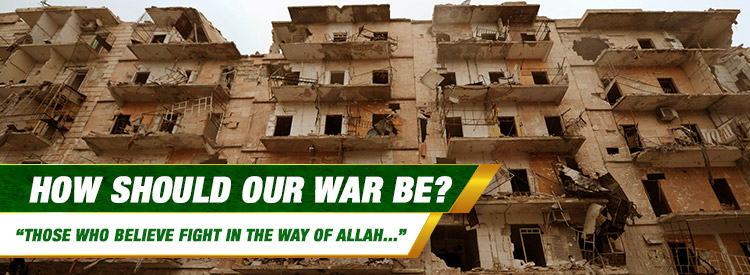
“And why should ye not fight in the cause of Allah and of those who, being weak, are ill-treated (and oppressed)? - Men, women, and children, whose cry is: "Our Lord! Rescue us from this town, whose people are oppressors; and raise for us from thee one who will protect; and raise for us from thee one who will help!" Those who believe fight in the cause of Allah, and those who reject Faith Fight in the cause of Evil: So fight ye against the friends of Satan: feeble indeed is the cunning of Satan.” (an-Nisa, 4/75-76)
When the verses related to war are studied, it is seen that Islam allows it only to remove oppression, pressure due to religion and unjust attacks.
Since Allah does not need anything, to fight for His consent means to fight for the benefit of His servants and to ensure freedom of religion and conscience.
Those who do not believe in Allah and the true religion also have gods and - material, spiritual - leaders that they obey. These leaders are Satan and transgressors according to the Qur'an.
The purpose of war of those who are subject to them is not the realization of law and justice but the satisfaction of their egos, oppression, pressure and exploitation. When the wars they made throughout history are studied, it is possible to see many horrifying examples of this divine determination.
The purpose of man's creation is worshipping Allah and submission to Him. Servitude and obedience is an indivisible whole.
Man cannot fulfill the duty of worshiping, cannot get rid of polytheism and cannot be a person of oneness unless he leads his life – as an indivisible whole - in the consciousness of being a slave of Allah and looking for His will and consent.
As Garaudy puts it,
"It is necessary to pay attention to the following fact in order to understand why Prophets insistently invited people to be a slave of real Allah, who is one, and to abandon worshipping of other powers (taghut) other than Allah: the real source of evil and corruption is some people being gods of others either directly or indirectly."
"When you examine history, you will see that people are not godless and that they either worship the real God or they obey people, groups, classes and parties that put themselves in the place of God."
"It is necessary for people to believe in a superhuman power and a greater and loftier reward than the pleasures of the world life in order to be able to establish social balance. If people do not recognize the divine authority and are unaware of the reckoning of the Day of Judgment, they will live as prisoners of the borders of their own souls. A person who replaces Allah with man will also replace man with himself because another person does not have a different property from him (he is also a human being)."
"The goal of those who do not have any expectations but the world life and worldly pleasures will be getting the biggest share from the world; its inevitable result will be egoism, material pragmatism, oppressing and exploiting the weak."
The following answer given by Rib'iyy b. Amir, a Muslim, at the beginning of the War of Qadisiyya to the question of Rustam, the commander of the Persians, "Why did you come here?" is an eloquent expression of the universal purpose:
“Allah sent us to deliver those whom He wished from worshiping slaves to worshiping Allah, from the constriction of this world to the vastness of this world and from the oppression of the (distorted) religions to the justice of Islam. Allah sent us to your people so that we will call them to the true religion.”
The aim of the Islamic conquests is ensuring freedom of religion, conveying the message of the true religion and the establishment of justice.
There is no compulsion in religion and Allah does not love oppressors.
Tafsir scholars have not been able to reach a consensus about drawing a conclusion by analyzing the verses about war and peace as a whole. According to those who understand the purpose of the war as no polytheists being left in the world or the believers dominating the world, the decree of the verses that order peace were abrogated by the following verses that were sent down afterwards:
The verse ordering to slay the pagans wherever they are found (at-Tawba, 9/5), the verse ordering Muslims to fight the People of the Book until they pay jizyah with willing submission and feel themselves subdued (at-Tawba, 9/29), and the verse
"Be not weary and faint-hearted, crying for peace when you should be uppermost." (Muhammad, 47/35)
The second view stated against this understanding by Abu Bakr Ibn al-Arabi (II, 875 ff) and Jassas (III, 68) is as follows:
The pagans to be slain wherever they are found are the polytheists that lived in the Arabian Peninsula and that were determined to eliminate Muslims.The permanent decrees of the verses have nothing to do with them. War and peace are based on the power and interests of the Muslims and the purposes of the religion; accordingly, it is permissible to fight, to make peace by offering peace or accepting the offer of the other party, and to take or give something in return for peace. The verses did not abrogate each other; they showed how to act depending on situations.
As a matter of fact, the Prophet made a peace treaty with some Jewish and polytheistic groups acting accordingly when he came to Madinah; similarly, he signed the Peace Treaty of Hudaybiyyah with Makkan polytheists but the other party violated the treaty by declaring war against the tribe of Khuzaa, who had made a common defense agreement with Muslims. He also signed a peace treaty with the Christians of Najran. When the Muslims got stronger, they offered the People of the Book to become Muslims or to pay jizyah and the polytheists of the Peninsula "to become Muslims, to leave the region or to die". Applying the decree "war and peace need to be carried on based on the principles of power, benefits and legitimate purposes, and the People of the book and polytheists need not to be treated differently" continued during the period of the first caliphs too.
War is almost as old as humanity.It is not possible to protect the rights of innocent, sinless people by abolishing capital punishment; similarly, it is not possible to secure peace and justice in international relations and to prevent oppression and evil by abolishing and eliminating war. What needs to be done is to determine the legal and ethical purposes of war and not to make it deviate from this purpose. When the verses about war are studied, it will be seen that Islam allows war only to eliminate oppression and pressure because of religion and unjust attacks.
The two verses mentioned in the introduction (an-Nisa, 4/75-76) show two important purposes of war:
a) consent of Allah,
b) preventing oppression and securing justice.
"Consent of Allah" benefits His slaves. Since Allah does not need anything, to fight for His consent means to fight for one's own benefit and to secure the freedom of religion and conscience. Since Allah is absolutely just and does not give consent to the slightest oppression, "to fight for the consent/sake of Allah" means to fight for justice, law and truth. Those who do not believe in Allah and the true religion also have a god, a material, spiritual leader that they obey, including their soul; according to the Quran, these leaders are taghuts (transgressors) and devils; the purposes of war of those who follow them are not to secure law and justice but to satisfy their egos, oppression, pressure and exploitation.
Verses 39 and 40 of the chapter of al-Hajj show very clearly the attitude of Islam toward different religions and faiths. The temples that Allah and His mujahid slaves that obey Him protect are not only mosques but also other places of worshipping belonging to other religions. According to Islam and in reality, Allah is one/unique; so, those who mention Allah's name but who mean another being or who mention His name with qualities that do not fit Him also mention Allah intentionally or unintentionally, rightly or wrongly. To punish or to suppress some people in the world because they believe in a different religion or because their faith is contrary to a certain religion is something that Islam regards as casus belli, let alone regarding it permissible.
Armed struggle and violence becomes oppression and terror when it oversteps boundaries that are regarded as legitimate by religion, law and ethics in terms of its purpose or form; it is impossible for Islam to approve it or to regard it permissible.
It is necessary to attract attention to the difference between the man that Islam wants and between the Muslims of today in every field from worshipping to social, political, legal, ethical, etc. life; to notice this difference is an important step in the journey of worshipping/slavery.
“How did the ummah become virtually dead like that?”
Because the ummah sought power and prestige in being together with non-Muslims, not in trusting Allah and being together with Muslims and because the belief of the ummah weakened.
We quote some verses that inspire this thought:
“If any do seek for glory and power,- to Allah belong all glory and power. To Him mount up (all) Words of Purity: It is He Who exalts each Deed of Righteousness. Those that lay Plots of Evil,- for them is a Penalty terrible; and the plotting of such will be void (of result).” (Fatir, 35/10)
They say, "If we return to Medina, surely the more honourable (element) will expel therefrom the meaner." But honour belongs to Allah and His Messenger, and to the Believers; but the Hypocrites know not.” (al-Munafiqun, 63/ 8)
“So lose not heart, nor fall into despair: For ye must gain mastery if ye are true in Faith. / If a wound hath touched you, be sure a similar wound hath touched the others. Such days (of varying fortunes) We give to men and men by turns: that Allah may know those that believe, and that He may take to Himself from your ranks Martyr-witnesses (to Truth). And Allah loveth not those that do wrong.” (Aal-i Imran, 3/139-140)
Almighty Allah reminded the believers who were defeated in the Battle of Uhud of their victory in the Battle of Badar and the defeat of the polytheists in order to console them. In addition, He gave victories and defeats to people by turns with the purposes mentioned in the verse and made both sides experience both bad and good days. Otherwise, the fact that the worldly life is a test would be of no value, and the possibility of believing with free will would disappear.
“Be not weary and faint-hearted, crying for peace, when ye should be uppermost: for Allah is with you, and will never put you in loss for your (good) deeds. / The life of this world is but play and amusement: and if ye believe and guard against Evil, He will grant you your recompense, and will not ask you (to give up) your possessions.” (Muhammad, 47/35-36)
Here, the believers are not prohibited from seeking peace but it is not regarded appropriate for them to seek peace before enemy when they are superior or by displaying weakness and slackness though being a believer also includes superiority and honor; it is indicated that such an attitude will encourage the enemy and hence it will not enable the believers to attain the goal of “establishing a world system in which peace, justice and freedom of religion will be dominant”.
In those verses, Allah Almighty clearly states that honor and material and spiritual power will belong to Muslims thanks to the permission and help of Allah and the belief, trust and efforts of believers.
Then, why are we, as the ummah, weak and in a position to ask help from unbelievers, who are our enemies? Because we are Muslims by name, but our belief, consciousness and deeds are away from Islam.
